I am thinking about the long list of places I will apply to for residency in a few short months. The list is growing by the week, but two just got crossed out: The University of Arizona and St. Joseph's Hospital in Phoenix. I figured I don't want to spend 5 years living in a place where I'll be asked to "show my papers."
Tuesday, April 27, 2010

Friday, April 23, 2010
Out of the psych ward
Just got done with psychiatry. I had a great time. I was in a general adult ward where most patients were voluntary. The staff was great and the patients were very interesting. What was really cool was that in their short stay of 3 to 5 days, most patients actually got better... not something I thought would happen quickly. What was even cooler was that there were no residents, so I was actually a useful part of the team and my patients were my patients. I got to interview them first, I got to write their admission notes, I got to do their discharges. This is probably the closest I've felt to a doctor.
Just for fun, here's something amusing that happened during the rotation:
Attending (while talking to a crack addict that didn't want to stop): You need to stop smoking rock and get addicted to something else. Like this (shows a picture of his cat). You can start getting high off of this.
...
Me (later): Dr. X do you watch South Park?
Attending: Yes
Me: Do you remember the episode where they get high off of cat urine?
Attending: It's called cheesing.
...
Attending (later, to patient): You should probably ignore what I said earlier about getting high off your cat. It's called cheesing and it's bad.


Just for fun, here's something amusing that happened during the rotation:
Attending (while talking to a crack addict that didn't want to stop): You need to stop smoking rock and get addicted to something else. Like this (shows a picture of his cat). You can start getting high off of this.
...
Me (later): Dr. X do you watch South Park?
Attending: Yes
Me: Do you remember the episode where they get high off of cat urine?
Attending: It's called cheesing.
...
Attending (later, to patient): You should probably ignore what I said earlier about getting high off your cat. It's called cheesing and it's bad.
Monday, April 19, 2010
Taking Oaths
I thought that the only oath I'd be taking in med school is the Hippocratic oath. But, in more than one rotation, I've had to sign papers that certified that I really did read the reading I was assigned or watched the video I was assigned. It's frustrating on two levels. One is that I find oaths in general kind of useless. If someone is going to do something wrong or illegal, they're not going to have much of a problem lying about it. What's more upsetting though is the paternalistic approach that medical schools have towards their students. If there is a reading or video that is recommended, it should be up to me to decide whether I think it's useful to my education. If I don't find it useful, actually doing the assignment will only waste my time. I believe that we're mature enough to decide what the best way for us to study is. I've had hundreds of exams and know pretty well what works for me. The school shouldn't care (and shouldn't make me sign oaths) that I didn't do a particular assignment.
Of course, the administrators don't really remember being students, so they've implemented things like quizzes that ask questions about topics that were in the readings, but not exactly important to clinical practice or (rumor has it) actually make sure that you've clicked on and watched the entire 26 minutes and 13 seconds of the video that is posted on line. This is what happens when you lose sight of priorities... so, if you'll excuse me, I've got to play another video at 2X speed with the sound muted in the background.
Of course, the administrators don't really remember being students, so they've implemented things like quizzes that ask questions about topics that were in the readings, but not exactly important to clinical practice or (rumor has it) actually make sure that you've clicked on and watched the entire 26 minutes and 13 seconds of the video that is posted on line. This is what happens when you lose sight of priorities... so, if you'll excuse me, I've got to play another video at 2X speed with the sound muted in the background.
Wednesday, April 7, 2010
Best burger in baseball?
I was watching the travel channel and saw this beauty:

A bacon cheeseburger with a Krispy Kreme donut as buns. Looks like I have a good reason to apply for residency in St. Louis.

A bacon cheeseburger with a Krispy Kreme donut as buns. Looks like I have a good reason to apply for residency in St. Louis.
Friday, April 2, 2010
Someone who shouldn't be a doctor
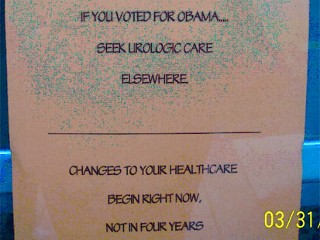
This sickens me. I would hope that other doctors in the area realize that he's an asshole who won't treat his patients equally and refer their patients with urological problems elsewhere.
(part of me thinks, I'm glad that he's advertising his idiocy and losing patients)
Wednesday, March 31, 2010
Psychobabble
I just started psychiatry this week and so far, it's been pretty good. I feel pretty comfortable talking to the patients I've had so far (although, they really haven't been out there, so I've got plenty of more chances to feel uncomfortable). Although I'm glad that we don't see much of it in medicine these days, in the 3 short days that I've been on psych, I've been exposed to the psychoanalytic model (Freudian stuff) more than I'd like (including part of our formal lectures). As a scientist who believes in theories based on objective experiments, I find it incredibly hard to believe the ideas in the psychoanalytic model. I mean, it's hard to believe that there are actually trained physicians (though decreasing in numbers) that actually believe stories about things like the "oral phase," the "id versus the ego," or the un(sub or whatever)conscious. It all really sounds like the quack cult psychology books (like The Secret) that Oprah and other daytime talkshow hosts promote. I know that the mind is difficult to understand and we essentially know nothing about where psychiatric disorders come from, but do we really need to make up colorful stories about some sort of hidden internal struggle in the brain? Some ideas may be useful in developing a treatment strategy, but still using outdated ideas and teaching untestable stories seems a little backwards to me.
Thursday, March 25, 2010
Patient confidentiality vs. Public safety
A 19 year old woman came to the ED reporting that she had been raped by a taxi driver. She wanted emergency contraception and wanted to be tested for sexually transmitted infections. She said that she was alone in the taxi, the driver took her to secluded park, raped her and left her at the park. She would not describe the taxi driver, say which company he worked for, or give any details about what happened. She did not want to press charges because she did not want to questioned by the police (she stated that her sister had been sexually abused and went through a terrible time having to relive her experience over and over again after she reported to the police). The attending (and I) were in a conundrum. If what happened to her isn't reported to the police, a taxi driver can very well rape (or murder) someone else. If what happened is reported to the police, we'd be breaking her confidentiality (and making her go through a lot of grief). Eventually, the nurses contacted the hospital lawyers who (probably to save their asses) said that legally we can't break her confidentiality. So, even though it gave both the attending and I a terrible feeling, we let her go and didn't report anything.
Later in the week I talked to a medical ethicist at our institution about this. He didn't say anything clear cut. But, he reminded me that confidentiality can be broken if the information we reveal has a high probability of saving the patient's life or the lives of others. So, assuming she's telling the truth (not sure if she is) and there is a high probability that the taxi driver would rape again (and statistically speaking, it is), ethically we should have reported the incident. Is that right? I'm still on the fence about this. I just hope I don't hear anything about a cab driver raping someone else on the news.
Later in the week I talked to a medical ethicist at our institution about this. He didn't say anything clear cut. But, he reminded me that confidentiality can be broken if the information we reveal has a high probability of saving the patient's life or the lives of others. So, assuming she's telling the truth (not sure if she is) and there is a high probability that the taxi driver would rape again (and statistically speaking, it is), ethically we should have reported the incident. Is that right? I'm still on the fence about this. I just hope I don't hear anything about a cab driver raping someone else on the news.
Subscribe to:
Posts (Atom)