OK, now that I'm nearly a year out from becoming a doctor, I've gotten a chance to be on the other end of medical school for long enough to try to give some advice to those going through medical school now. I've worked with several medical students and have picked up a few things about what makes a medical student a successful member of the team.
1. Get to know your patients. You have more time than everyone else on the team. So, get to know your few patients as well as you can. First, it's an interesting experience and you'll build a great relationship with the patient. You'll gain the patient's trust and may be able to get more information from the patient than any resident or attending will. With this, you'll add to the patient's care more than any resident will. I've seen patients specifically asking to see the med student rather than the resident or attending because of the close relationship they've built.
2. Think for yourself. Come up with a plan of what you want to do right after you see the patient and before you talk it over with a resident or attending. Don't worry about being wrong. It will quickly help you figure out how different conditions are tested and treated.
3. Do your work. Don't copy the work of others. I know that med student notes are usually ignored by everyone, but it's something you need to learn to do on your own since you'll be using it for the rest of your life. I've seen several med students directly copy notes from residents... not cool and not unnoticed.
4. Don't make your teammates look bad. This includes pimping your residents, showing off about what you know or have learned or volunteering for more than what is expected of you. A medical student I worked with volunteered to give a presentation during our medicine rotation. No one asked anyone to give a presentation, but he thought he'd look eager and interested if he volunteered out of his own initiative. It backfired terribly. Even if the talk had gone well, it upset the residents because it took time out of the day and it made the other medical students look bad and feel that they need to do the same thing. Kissing ass can get you far in med school, but it can also terribly backfire, so better to not do it.
5. Ask questions. There are no stupid questions. Lots of what you have questions about, other, more senior team members probably also have questions about.
6. Don't pretend you're going into the field of whoever you're talking to. They'll see right through you.
7. There are some things you should not emulate. Interns will complain. They will bitch. They will make fun of attendings, patients, each other. They will slack off. You cannot do that. Despite all the complaining and slacking, they will get their work done. You just started, you have a lot of studying to do and can't afford to waste time like they do.
8. Don't lie. If you forgot to look something up or didn't get a chance to see a patient, don't make up numbers or a physical exam. There was a medical student who forgot to pre-round on one of his patients and just made of the physical exam (it was a surgery rotation, so he was actually pretty close to being right). He got caught when he went to the patients room and didn't realize that the patient had moved to a different part of the hospital the night before.
9. Don't be scared, upset or angry about criticisms you hear from others. Think about it. If it's justified, learn from it. Don't take it personally. Don't think it'll ruin your grade.
I'm sure there is more, but these are the ones that jumped at me with the med students I worked with in the last year.
Showing posts with label education. Show all posts
Showing posts with label education. Show all posts
Tuesday, June 5, 2012

Sunday, May 6, 2012
A dangerous doctor
C = M.D.
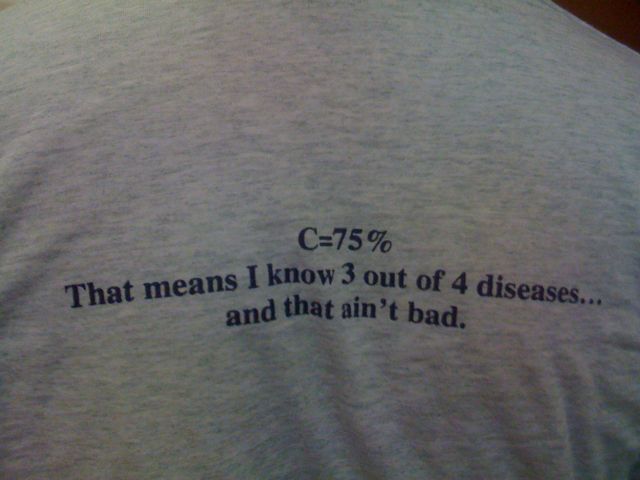
Medicine, though always seen as a rigorous field that only the smartest and strongest make it through, is actually a very formulaic process of which the hardest part is probably getting into medical school. A few often repeated axioms in medical school are: "What do you call someone who graduated last in their med school? Answer: A doctor" and "C = MD". Of all entering US medical students, 96% eventually graduate with a medical degree (in comparison, the same measure for graduate students in 62%). Most who fail to graduate, drop out of medical school for personal reasons, not because they were not qualified. Of those that graduate who want to practice medicine, all eventually find a residency program. With residency, it's a similar pattern. It is rare, but residents can be kicked out of their program. However, most find another residency program that is willing to take them. There are boards exams, but in many fields you don't need to be board certified to take care of patients, the pass rates are high and you can take them repeatedly until you pass. Of course, once you complete residency, even outright fraud or criminal negligence doesn't necessarily get your medical license taken away from you (I'm looking at you doctors who only serve as a prescription mill for narcotics).
The point here is that once you get into medical school, there is very little stopping you from eventually being a practicing physician. There are several problems. One is that there is a shortage of physicians out there and in many fields, such as family practice and internal medicine, there is a large number of open spots that need to be filled. A second problem is that medical schools and residencies thrive on their reputations. If their graduation rates decrease due to failure of a student or resident, it affects their statistics and makes the program less appealing to future applicants. Finally, there is a culture of avoiding confrontation in medicine. It's easier to pass someone than to deal with the trouble of remediation or removing the person from the program.
Please don't get me wrong. A vast majority of my coworkers and, likely, residents in other hospitals, are fine physicians who will serve their patient's well. However, the culture of passing everyone through the system, even if they are unqualified, has got to go. Patient's lives should be of primary concern.
Monday, April 19, 2010
Taking Oaths
I thought that the only oath I'd be taking in med school is the Hippocratic oath. But, in more than one rotation, I've had to sign papers that certified that I really did read the reading I was assigned or watched the video I was assigned. It's frustrating on two levels. One is that I find oaths in general kind of useless. If someone is going to do something wrong or illegal, they're not going to have much of a problem lying about it. What's more upsetting though is the paternalistic approach that medical schools have towards their students. If there is a reading or video that is recommended, it should be up to me to decide whether I think it's useful to my education. If I don't find it useful, actually doing the assignment will only waste my time. I believe that we're mature enough to decide what the best way for us to study is. I've had hundreds of exams and know pretty well what works for me. The school shouldn't care (and shouldn't make me sign oaths) that I didn't do a particular assignment.
Of course, the administrators don't really remember being students, so they've implemented things like quizzes that ask questions about topics that were in the readings, but not exactly important to clinical practice or (rumor has it) actually make sure that you've clicked on and watched the entire 26 minutes and 13 seconds of the video that is posted on line. This is what happens when you lose sight of priorities... so, if you'll excuse me, I've got to play another video at 2X speed with the sound muted in the background.
Of course, the administrators don't really remember being students, so they've implemented things like quizzes that ask questions about topics that were in the readings, but not exactly important to clinical practice or (rumor has it) actually make sure that you've clicked on and watched the entire 26 minutes and 13 seconds of the video that is posted on line. This is what happens when you lose sight of priorities... so, if you'll excuse me, I've got to play another video at 2X speed with the sound muted in the background.
Friday, March 12, 2010
Take back our textbooks
As expected a bunch of nuts in Texas decided that reality is too liberal and will rewrite history and make up scientific facts to teach students in their public school system. I could say, "who cares it's only Texas", but the publishers don't want to make multiple versions of a textbook and since Texas is one of their largest purchasers of textbooks, the right-winged fake textbooks that they'll make for Texas will be used in other states also. However, I believe we could fight back. The same publishers sell college and professional-level textbooks, and with the insane number of textbooks that I've had to buy in my college and professional school career, I'm sure a huge chunk of the revenue for these companies come from people just like me. So, if professors, researchers, and college students boycott the companies that are complacent in the brainwashing of public school students, I believe we could stop these 11 crazy Texans from robbing the educations of kids from all over the country. (I've tried to find a list of the textbooks that the Texas school board uses, but haven't been successful so far.)
Thursday, December 3, 2009
Learning Abortion
We had a pretty interesting discussion about how education about termination of pregnancy fits in with resident education in OB/GYN. According to the accreditation board, no residency program can require that residents participate in a termination of pregnancy. However, all residency programs are required to accommodate residents who wish to learn about and participate in such procedures. This applies even if it's a Catholic hospital/university that provides no such services (and equates such services to murder*). Such hospitals have an agreement with another institution that does provide it. Which means that it is possible that somewhere in the country, an anti-abortion institution has an agreement with an institution like planned parenthood that provides abortion services in order for them to keep their accreditation**. I wonder what the atmosphere was at the meeting that led to that agreement. And, how stigmatized is the pro-choice resident in an anti-choice hospital, if they do decide to take this option? Also, how likely is an interested resident going to take the option if the nearest clinic providing abortions is hundreds of miles away?
Another interesting part of this discussion was that each institution has an unspoken reputation about whether it has a pro-choice or anti-choice lean. And, although it is illegal for them to use the applicants views on abortion as a litmus test, according to the attending we were talking to (who has been intimately involved in national ob/gyn resident education), these institutions do look for clues on the residents' applications about where they stand on the issue (i.e. if they said they were a member of Medical Students For Choice) in order to make decisions on whether to interview them or not. Sounds like a litmus test to me.
* though, in my opinion, they really don't. See this discussion.
** although, some of them do get around it by saying that their abortion training is "limited to patients with medical indications," which can equate to early induction of labor and is not really what most people think of as abortion.
Another interesting part of this discussion was that each institution has an unspoken reputation about whether it has a pro-choice or anti-choice lean. And, although it is illegal for them to use the applicants views on abortion as a litmus test, according to the attending we were talking to (who has been intimately involved in national ob/gyn resident education), these institutions do look for clues on the residents' applications about where they stand on the issue (i.e. if they said they were a member of Medical Students For Choice) in order to make decisions on whether to interview them or not. Sounds like a litmus test to me.
* though, in my opinion, they really don't. See this discussion.
** although, some of them do get around it by saying that their abortion training is "limited to patients with medical indications," which can equate to early induction of labor and is not really what most people think of as abortion.
Tuesday, October 27, 2009
Cleaning up
With a (much) lighter schedule, the Mrs. and I decided we should start getting ready for the baby getting here. The first order of business is to make room for the baby. This means throwing a lot of crap away. Most of the "crap" was notes and folders from undergrad and the first two years of med school. I've somehow felt attached to these notes, even though very little of it is useful to me anymore (really, I don't need to hold on to my History of Jazz notes). But they had to go. And as I was throwing things away, I saw my Calculus 3 notes and flipped through it and I was amazed that at some point in my life I knew how to do triple integrals. Then I thought, holy shit, what a waste of time. I haven't used it since and will probably never use it again. Was it all a waste? I wonder how much of my education is a waste?
Subscribe to:
Posts (Atom)