Showing posts with label intern year. Show all posts

Monday, June 11, 2012

Reflections on intern year

... or was it worth it?

When it comes to intern years, I had a pretty benign one. Nonetheless, I learned a lot. The difference between a year ago and now is mostly a great build-up of confidence. Rather than freaking out with every small aspect of caring for a patient, I feel pretty comfortable with most cases, even some very serious ones. Yes, there is a lot of book knowledge and practical knowledge that I've built over the years and I certainly do feel more like a doctor. I've also had a lot of fun and made some good friends. However, was it worth it for me? Will I be a better radiologist after having gone through intern year. It's hard to tell now. Most radiologists I've asked remember almost nothing from their intern year and say that it is a waste of a year. Most internists I talk to say that the experience I've had in various fields on inpatient (and outpatient) medicine will make me a more effective radiologist. They say that I'll remember the patient's I've seen and those experiences will help me come up with a better diagnosis. I think that they're both wrong. I'm sure I'll remember some of what I've experienced this year and it will likely affect how I interpret images. However, rather than being better at making the right diagnosis, what I likely gained from this year is being able to communicate with various physicians of other specialties. It's definitely useful to know what others are interested in (or worried about) when your opinion is asked. In reality, I won't be able to tell whether this year was helpful to my career until I'm well into my career. Even then, I won't know whether what I did this year is better than having a 5-year, all radiology residency. All I can say is that it was (mostly) fun and I've had amazing experiences that I will carry with me for the rest of my life. I can also say that, for at least one year, I felt like a real doctor.

 The only use for my stethoscope from now on (image source)

Tuesday, June 5, 2012

Guide to medical students

OK, now that I'm nearly a year out from becoming a doctor, I've gotten a chance to be on the other end of medical school for long enough to try to give some advice to those going through medical school now. I've worked with several medical students and have picked up a few things about what makes a medical student a successful member of the team.

1. Get to know your patients. You have more time than everyone else on the team. So, get to know your few patients as well as you can. First, it's an interesting experience and you'll build a great relationship with the patient. You'll gain the patient's trust and may be able to get more information from the patient than any resident or attending will. With this, you'll add to the patient's care more than any resident will. I've seen patients specifically asking to see the med student rather than the resident or attending because of the close relationship they've built.

2. Think for yourself. Come up with a plan of what you want to do right after you see the patient and before you talk it over with a resident or attending. Don't worry about being wrong. It will quickly help you figure out how different conditions are tested and treated.

3. Do your work. Don't copy the work of others. I know that med student notes are usually ignored by everyone, but it's something you need to learn to do on your own since you'll be using it for the rest of your life. I've seen several med students directly copy notes from residents... not cool and not unnoticed.

4. Don't make your teammates look bad. This includes pimping your residents, showing off about what you know or have learned or volunteering for more than what is expected of you. A medical student I worked with volunteered to give a presentation during our medicine rotation. No one asked anyone to give a presentation, but he thought he'd look eager and interested if he volunteered out of his own initiative. It backfired terribly. Even if the talk had gone well, it upset the residents because it took time out of the day and it made the other medical students look bad and feel that they need to do the same thing. Kissing ass can get you far in med school, but it can also terribly backfire, so better to not do it.

5. Ask questions. There are no stupid questions. Lots of what you have questions about, other, more senior team members probably also have questions about.

6. Don't pretend you're going into the field of whoever you're talking to. They'll see right through you.

7. There are some things you should not emulate. Interns will complain. They will bitch. They will make fun of attendings, patients, each other. They will slack off. You cannot do that. Despite all the complaining and slacking, they will get their work done. You just started, you have a lot of studying to do and can't afford to waste time like they do.

8. Don't lie. If you forgot to look something up or didn't get a chance to see a patient, don't make up numbers or a physical exam. There was a medical student who forgot to pre-round on one of his patients and just made of the physical exam (it was a surgery rotation, so he was actually pretty close to being right). He got caught when he went to the patients room and didn't realize that the patient had moved to a different part of the hospital the night before.

9. Don't be scared, upset or angry about criticisms you hear from others. Think about it. If it's justified, learn from it. Don't take it personally. Don't think it'll ruin your grade.

I'm sure there is more, but these are the ones that jumped at me with the med students I worked with in the last year.

Sunday, May 27, 2012

God's medicine

  I had a patient recently who suddenly developed an irregular heart beat. There are lots of things that could cause this, including many medications. I asked the patient what medications she was taking and she said none. A few minutes later, looking around her room, I saw a large tub filled with pill bottles. I pointed to them and asked her what they were. She said, "Oh, just my herbals." I told her that herbs are made of chemicals and some of them can interfere with her heart rate (or with the blood thinners and heart rhythm medications we were giving her). She said, "No, they aren't chemicals. They are natural." I explained how many of our modern medicines comes from plants. She smiled, agreed wholeheartedly and said, "Yes, plants are natural medicines." I said that she was right and she should realize that medicines, even natural medicines, can have side effects. She replied, "No, medicines you give me have side effects because they are man made. Natural medicines are made by God and He has made sure that they don't have side effects." I knew I had no chance to convince her why what she was doing was dangerous. I looked through her box of supplements and didn't recognize most of them, but there were some known to be stimulants and others known to interact with blood thinners. I told her not to take those few (5 of the more than 30). She declined saying she trust's God's medicines more than mine. I spent a few minutes explaining why we were so worried, but got no where. When I left she said "God bless you." Mixing quackery with religion makes a dangerous thing deadly.
  I'm not too surprised that quackery and religion go hand in hand. With both you are convinced that you know the truth, that whatever else is out there is a lie and if there is a conflict between the two, you are always right. With both, there is no critical thinking. With both, rather than reasoning with someone trying to convince you otherwise, you get offended. With both, you bend over backwards trying to ignore the obvious deficiencies with what you believe in.

Tuesday, May 22, 2012

The danger of quacks

  A major argument that supporters of alternative medicine use is that it causes no harm, so they might as well try it. Of course, that's pure crap. Alternative treatments cause harm in numerous ways: Untested drugs and techniques have side effects and interactions, they're a huge waste of money, and, most importantly, they keep patients from receiving actual treatment that works.
  Case in point is a former patient that I recently ran into in the emergency department. Nine months ago, she was a perfectly healthy mother of two that was successful in her career. One of the sweetest patients I've had all year. At that time, she was admitted for new muscle pains. We ran many tests, figured out it was an autoimmune condition, gave her steroids and connected her with a rheumatologist to make the final diagnosis and for long-term management. She improved a little and went home with a plan in hand.
  Nine months later, I find her disheveled in the emergency room's psychiatric evaluation room (where you can't hurt yourself) screaming at no one in particular. It turns out that she was eventually found to have polymyositis, an autoimmune condition that affects the muscles and can be hard to treat. She had improved with steroids when I saw her 9 months ago, but a few months afterwards had another flare and went to a holistic "doctor" instead. The quack told her that she has "chronic Lyme disease" and that the her rheumatologist was wrong. He then tricked her into trying various herbs, potions, "magnetized water treatments" and none of it worked (somehow, antibiotics never came to his mind). She went had her primary care physician test her for Lyme disease and it kept on coming back negative. But, she insisted that she had Lyme disease. She became obsessed with having Lyme disease and spent more and more money on hyperbaric oxygen chambers, toxin removers, colon cleansing, etc. She lost tens of thousands of dollars and kept on getting fleeced by the holistic "doctor". Her relationship with her family became strained and she eventually attempted to commit suicide. Hence, her arrival to the emergency room.
  I won't blame the quack for causing her to become psychotically obsessed with her medical condition. Despite having no previous psychiatric illnesses, she must have had some underlying condition. What I do blame him for is playing on these beliefs to make money off of her. I blame him for convincing her that her doctors are wrong, that the tests were wrong and that they are trying to keep the truth of his fake medicine from her. Not all quacks are out to fleece people (some of them actually believe what they're selling), but all of them, whether intentionally or not, keep people from getting the treatments that they need. Luckily, she survived her suicide attempt, but this quack nearly had blood on his hands.

St. Jacobs Oil or Prednisone? (image from here)

Monday, May 14, 2012

Hospitalists

  This month I'm working on a cardiology consulting team and with it, I've gotten a lot of exposure to the hospitalist side of internal medicine. Hospitalists are internal medicine physicians who only take care of patients in the hospital. They have no clinics and only deal with the short-term problems that the patient is hospitalized for. In effect, they do my internal medicine rotation all the time (except they are the entire team). It sounds terrible. One colleague called it "residency for life." However, it has it's benefits. It is essentially shift-work, so it has a pretty nice schedule. Most people go into it straight out of residency (so only 3 years after finishing medical school). Most hospitalists work a week on followed by a week off. So, a vacation every other week. They also get paid pretty well. 200000+ for working a total of 6 months each year. Because of these benefits, it's quickly becoming a popular choice.
  The problem comes with not having ownership of the patients. Without any continuity of care, hospitalists don't know their patients as well as internists who also have a primary care clinic. With the shift-work schedule, their is a lot of passing patients between hospitalists and resulting poor communication. Also, with 20+ patients a day, there isn't much time spent with each individual patient. Putting all this together, hospitalists tend to not think about each individual case as much. At least that's the trend I've seen when consulting for a hospitalist versus consulting for a resident-run team or a team run by a regular internist. This doesn't mean that patients under the care of a hospitalist are at risk. The more common result is that they are overtested and specialists are overconsulted. If you don't have time to think about why someone is having chest pain, you get a chest X-ray, CT-scan, EKG, an echocardiogram, stress test and lots of blood tests and you consult a pulmonologist and a cardiologist. One of these will figure out what the problem is and your specialists will tell you what to do about it. I've seen this pattern quite a bit recently, including one case in which the hospitalist ordered these tests and consults prior to seeing the patients or even reading their previous notes (the patient was transferred from another hospital and through testing had already shown that his heart was fine).
  Of course, there are great hospitalists who know their patients well, think hard about each of the cases and use hospital resources efficiently. However, there is a disturbing number who are wasting resources and their consultants time as well as running up the cost of healthcare.

Sunday, May 6, 2012

A dangerous doctor

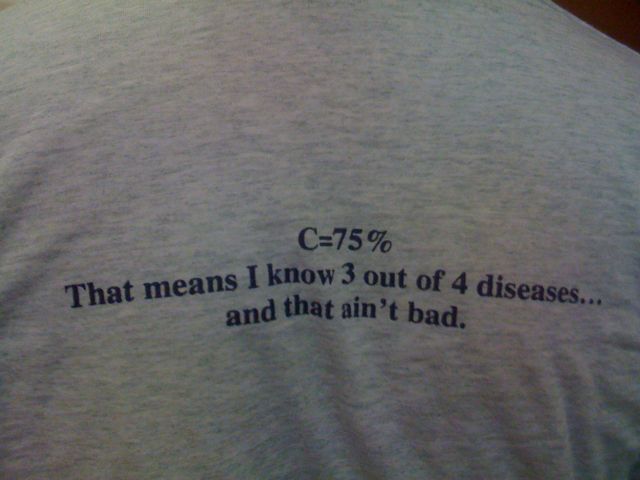
 C = M.D.

  I am doing my internship at a community hospital that mixes graduates from US allopathic schools (MD), US osteopathic schools (DO), American graduates from Caribbean medical schools and international graduates. Having worked with graduates from each of various programs, I knew, going in that a resident's background does not necessarily translate to their performance in the hospital. However, taking all the interns together, there definitely are some that are better than others, and there are a few that really should not be a doctor. For example, I worked with an intern who would like to become a cardiologist. He was asked to draw a heart and he simply did not know how the heart was organized. Not even close. When asked how he would treat someone with a complete heart block, he answered beta-blocker (which would kill the patient). If it was the beginning of the year, I could forgive him. If it was a one-time mistake, I could forgive him. But, this is someone who repeatedly shows that he has no clue how to treat patients. What's worse is that he actually thinks he knows it all. He manages patients without informing anyone of his actions (interns typically have senior residents or attending physicians to report to), because "it's an easy case" (Thank you, nurses, for catching his mistakes over and over again). He has been repeatedly corrected, but continues to make the same mistakes and even once uttering that the person correcting him "has no clue." He plagiarizes notes or writes notes and comes up with treatments without actually seeing the patient. This is a dangerous person. He has been caught and given chance after chance, but continues to make the same mistakes. Unfortunately, there is nothing stopping him and he will be a senior resident in a few short weeks.

  Medicine, though always seen as a rigorous field that only the smartest and strongest make it through, is actually a very formulaic process of which the hardest part is probably getting into medical school. A few often repeated axioms in medical school are: "What do you call someone who graduated last in their med school? Answer: A doctor" and "C = MD". Of all entering US medical students, 96% eventually graduate with a medical degree (in comparison, the same measure for graduate students in 62%). Most who fail to graduate, drop out of medical school for personal reasons, not because they were not qualified. Of those that graduate who want to practice medicine, all eventually find a residency program. With residency, it's a similar pattern. It is rare, but residents can be kicked out of their program. However, most find another residency program that is willing to take them. There are boards exams, but in many fields you don't need to be board certified to take care of patients, the pass rates are high and you can take them repeatedly until you pass. Of course, once you complete residency, even outright fraud or criminal negligence doesn't necessarily get your medical license taken away from you (I'm looking at you doctors who only serve as a prescription mill for narcotics).

  The point here is that once you get into medical school, there is very little stopping you from eventually being a practicing physician. There are several problems. One is that there is a shortage of physicians out there and in many fields, such as family practice and internal medicine, there is a large number of open spots that need to be filled. A second problem is that medical schools and residencies thrive on their reputations. If their graduation rates decrease due to failure of a student or resident, it affects their statistics and makes the program less appealing to future applicants. Finally, there is a culture of avoiding confrontation in medicine. It's easier to pass someone than to deal with the trouble of remediation or removing the person from the program.
Please don't get me wrong. A vast majority of my coworkers and, likely, residents in other hospitals, are fine physicians who will serve their patient's well. However, the culture of passing everyone through the system, even if they are unqualified, has got to go. Patient's lives should be of primary concern.

Tuesday, November 8, 2011

Asshole doctors: Less common, but still around

I am on a surgery rotation now and one attending I work with is a complete asshole. Now, surgeons are suppose to have a reputation of being assholes, but after a rather benign surgery experience in medical school (the worst I got was just not being acknowledged), I thought it was a thing of the past. For the most part, it is. However, there are still some physicians around who still perfectly fit the arrogant asshole stereotype.

Despite having gone through medical school, I do not know the intricacies of the types of prostheses or the indications for these types of prostheses. When an attending hears that I am not familiar with those types of equipment, they could respond in one of four ways: 1) Teach me the differences, 2) Direct me to someone who could teach me, 3) just tell me what to order, or 4) Sigh, yell at me for not understanding him, ask where I went to med school and why they didn't teach me that particular fact. Guess which one I got today.

At some point in the past, that type of response was the norm. I suppose it was somewhat of an effective way of teaching. It scarred residents enough to force them to remember it. Today, though, with the hospital working more like a system of individuals, each with their own expertise and responsibilities, rather than a boss that (thinks he) knows everything and his underlings. Today, people don't take to kindly to being treated like an underling. The nurses, physician assistants and administrative people who work with this physician just plain don't work as hard or as effectively because this guy is an asshole to everyone. To me, it doesn't really matter. I ignored most of what he said because I'll be leaving this hospital and won't be seeing him ever again. If I were to see him again though (perhaps as a radiologist), I'm not sure I'd go out of my way to make his life any easier (I just might do the opposite, as long as it doesn't harm patient care). If you're arrogant or an asshole in a hospital, it doesn't matter how experienced, educated or well-qualified you are, your co-workers that you depend on will make your life much, much harder.

Friday, October 7, 2011

General medicine is generally frustrating

Not because the medical decision making is difficult or the patients are a mystery. It's more that I spend most of the day doing work that really shouldn't be part of my job description. A typical medical admission is like this:

1. The ER or outside hospital has already diagnosed the patient, my job is to put in the basic orders to get them admitted and write a summary of what brought them in. Then, whether they came in with a diagnosis or not, consult a specialist and wait for their recommendations.

2. Fix their electrolytes, heart rate and maybe start them on some broad antibiotics while waiting for the specialist to see them.

3. Specialist sees them, gives recommendations, and I put in the recommendations into the computer system.

4. Wait for the patient to get better or wait for the specialist to tell me they can be discharged.

5. Figure out where they're being discharged to. Call medical offices to make them appointments. Call nursing homes, long-term care facilities to see if they'll take them.

6. Summarize everything that happened to the patient during their hospitalization.

Every once in a while, I feel somewhat like a doctor when I am answering patient's questions.

All important things, but, as you could see, there is very little actual medical decision making. It's very rare that I am reading up on various medical conditions and thinking about what tests to perform to figure out what's wrong with my patient.

Oh well. Glad I won't be doing that for the rest of my life.

Thursday, August 18, 2011

Update on sign out

OK, now that I've got some more experience on my belt. I gotta say that sign outs really aren't that bad. First, every morning the entire team rounds on every patient on the service, so even though I'm not managing every patient, the fact that I may be responsible for the patient at some other time gives me incentive to pay close attention. The fact that I have that incentive to pay attention has the added benefit of learning about a patients condition without doing all the busy work. The second reason why sign outs aren't that bad is that we're all getting better at effectively presenting patients to each other and writing effective notes. This is a skill that takes some time, but each week it gets better and better. So, now I'm willing to say that shorter hours and more sign outs (in the long run) is better for patients and residents than an overtired resident managing patients. Numerous studies have shown that sleep deprivation severely affects cognitive performance. So, I'd rather have fresh residents who need to spend some time getting to know patients versus an overtired, cognitively impaired one that knows their patient really well.

Tuesday, August 16, 2011

Signing Out

With the new work-hour rules for medical interns, the ICU is no longer a place where every 4 days an intern spends 30+ hours in the hospital. I'm glad for the rules. 12-18 hour days are bad enough. However, what it leads to is a lot of passing patients from one resident to another, which, in turn, leads to a general lack of ownership of a patient. It used to be that you admitted your patient to the ICU and for the next 20-30 hours, stabilized them and figured out what was wrong with them. You knew their history inside-out and knew how to manage them and what to look out for. Now, you may admit a patient, but 6 hours later, you've signed the patient out to the next intern. The sign-out is a five minute conversation relating the patients history, status and what to anticipate. The receiving intern know very little about the details of the patient and has to essentially start over. This leads to lots of information falling through the cracks. I recently got handed a patient that had been in the ICU for several days. He was stable enough to be transferred, which meant, I write out the discharge paperwork. Since I didn't know the patient, all of it is based on previous notes. I have to trust that those notes are completely accurate and thorough enough or something important about the patient could be missed. Unfortunately, many notes are neither completely accurate nor completely thorough.

It's a choice between having overtired residents who are prone to make mistakes or this. I'm not sure which is better.

Tuesday, August 9, 2011

The ICU

So, I finally get a day off from the ICU today. It's not bad, but there have been a few situations where I felt like I was biting more than I could chew. This is the place where the sickest patients go. It's pretty scary to be playing doctor with people who are just barely hanging on to life. Just a few hours ago, a patient of mine passed away. He crashed in front of my eyes and I can't help but look back at every order I made (or didn't make) to see if it could have been prevented. What's worse is that I can find things that really could have caused him to crash. I suppose this is the reason why the learning curve is so steep. If you don't pick it up quick, lives will be lost.

The fact that I, as someone who hasn't had any meaningful responsibility in a hospital, suddenly am seen by others (patients, nurses, family members) as an expert whose every wish will be carried out (if it's correctly entered in the computer) is terrifying. What's worse is that there never has to be a backup. Yes, there are other interns, residents and attendings, but there is a lot of on-the-spot decision-making that falls on me. Most of it is harmless, but there are times (especially at night) that it can irreversibly affect a patient's health. There are many orders I've put in that I am not confident of (or as a fellow intern said about an order a nurse suggested to her, "I don't know what it was, but I ordered it"). Things go very quickly, there's high patient turnover, and people die (signing your first death certificate is a pretty strange feeling).

I've only worked in the ICU for 7 days, but it's felt like a month. It's an experience where you learn a lot, but it wears you down. I'm glad I'm getting the experience, but I know it's not for me.

Sunday, August 7, 2011

Lost in the ICU

Talk about getting slammed! Working in the ICU doesn't leave much time for anything else. I should have known that when a fellow intern said that I should take care of all my bills before starting the rotation. I will try to have an update sometime soon.

Friday, July 22, 2011

Frustrating Patients

My attending and I have a pretty good relationship. Good enough that we can have a back and forth about politics (typically a no-no in the world of medical education and "professionalism"). He tends to point out my leftist tendencies and I point out his right-winged nuttiness. After 3 weeks of working in his clinic, which serves a rather impoverished part of the state, I can see his point of view.

Nearly half his patients have their healthcare covered by the state. This is great, but it seems like those same patients tend to do the worst at taking care of themselves. I don't mean eating right and exercising. I could understand if they didn't have the resources to do that. I mean they ignore doctor recommendations, then get an exacerbation of their disease, get admitted and have a hospital work-up that costs tens of thousands of dollars, get better, then go back and ignore every recommendation made to them. It's frustrating for a physician when a patient who is unemployed (and has no trouble with transport or any responsibilities at home) misses important appointments repeatedly or a patient who has all their medications paid for not taking them. Yes, some patients with good insurance also fall into this pattern, but from my admittedly short experience so far, it's a nearly universal pattern with those that are under the public health plan (and my attending agrees). One assumption I could make is that they have trouble following recommendations because they have a lot of other problems in their lives, but it's hard to tell if that's the case.

No, fear not dear readers (both of you), I'm not becoming a Republican (though my attending keeps on telling me that it's a matter of time). Rather, I think that there needs to be a shift in healthcare resources. Covering expensive medications and procedures is great, but I'd rather give those up for increased education of patients and more access to social workers. Preventative care looks great on paper, but in the real world, it only goes as far as patients know to take it.

Friday, July 15, 2011

Refill on the Vics

So two weeks into a non-academic community setting, I've learned what the real world is like. I'm not so surprised by fact that there are a lot of patients who are addicted to narcotics. I'm more surprised by how there are so many doctors that are feeding their addiction. It's so easy for a patient to find a doctor that will prescribe them some heavy-duty narcotics without too many questions that things that I learned in med school like counseling, pain contracts and limiting refills just plain doesn't work. If legitimate doctors to try to manage their patients' chronic pain without overly relying on narcotics they risk losing the patient and likely the patient's other chronic medical conditions won't be taken care of. Or, they can just write the refill to bring them back and make sure that they have their diabetes, high cholesterol, heart disease, asthma, etc. under control. It's a hard decision to make, but many of the patients in this area just won't see a doctor unless they need their pain meds refilled.

Sunday, July 3, 2011

Slow Start

So, I'm officially a doctor. July 1st was supposed to be a mind-numbing experience where I get thrown into the medical system, overwhelmed with things to do and actually get to feel like I'm making a difference in people's lives. Unfortunately, I feel like I've gone back a few years. I start with a primary care rotation. Primary care is not my thing, but I can appreciate the value of health maintenance and getting to know patients and I was looking forward to actually acting like a primary care doctor. To my surprise, I find out that all I do is shadow a physician while he sees his patients. It's worse than 3rd year. At least then I got to see patients beforehand. The clinic I'm at doesn't have electronic records, so I can't even read about the patients. I go in not knowing what's going on and about 30 seconds later come out not knowing what happened. The physician knows his patients and doesn't really need to go into the details that I would have needed in order to diagnose and treat (actually, I'm a little wary of how quickly he goes through patients). It's a complete waste of time. All I can say is that at least I get paid for it.

Tuesday, June 21, 2011

Last day of vacation

After nearly 3 months off, I'll finally be getting back to the medicine mindset with the start of intern year tomorrow (actually, it's just orientation tomorrow, the real intern year won't start for another week or so). I'm a little worried (ok, terrified might be a more accurate description). I've been calming myself down with the thought that lots of people have been through the same thing and have done fine, but with a 3-month break, I'm sure I'll be a little rusty. I suppose I took a 4-year break from medicine during graduate school and did ok when I got back into things, but med school is not the same as being an actual doctor who's orders actually get carried out. I was thinking of spending some time studying medicine, but there's little motivation to pick up a book and I figure that anything I could have learned on my own during the break would be minimal compared to the vast amount of information I'm about to get forced down my throat.

My mindset right now consists of many conflicts: I'm looking forward to actually starting work (I'm getting tired of being home all day), but at the same time, I know I won't have much of a chance for a break for a long time. I'm excited to see patients, apply my knowledge, try to help people and maybe have some fun along the way, but I'm also terrified I might make a mistake and hurt someone. I'm looking forward to meeting new people, but I'm afraid that they actually might know medicine. I'm terrified that I won't be able to handle the workload, but I'm calm because life at the community-hospital based intern year that I'll be going through won't be anything close to that of the academic-hospital based interns that I got to vicariously live through during my recent sub-I. I'm hoping for starting with something light so that I can get my bearings before getting slammed, but at the same time, I want to get the tough months over with before I get burnt out.

I figure it's no use worrying too much about it. It's not like I can change anything.

Saturday, April 9, 2011

House of God

With my time off, I recently started rereading Samuel Shem's House of God (must read for any medical type that hasn't read it yet). A novel about an intern learning the truth about how things work in the hospital. It has a lot of dark humor in it, but there's a lot that (even as a med student), I could tell is based on a grain of truth. For example, the type of patients you see at the hospital. You'd think that they'd be a cross-section of the population, but they aren't. I assume it's because those with repeat hospitalizations aren't exactly your average Joes. Upon meeting the patient who hides under the covers whenever his discharge is discussed or the patient that wants to keep his rectal tube in because he's too lazy to get out of bed to go to the bathroom, I was immediately reminded of the characters in the book. I wouldn't like to get to the point where I think about my patients as GOMERS or follow the Fat Man's Laws, but at least some of my experiences with medicine so far say that I may have to face days where it'll get close.

Here are the Fat Man's Laws (courtesy of Wikipedia):

  1. GOMERS DON’T DIE.
  2. GOMERS GO TO GROUND.
  3. AT A CARDIAC ARREST, THE FIRST PROCEDURE IS TO TAKE YOUR OWN PULSE.
  4. THE PATIENT IS THE ONE WITH THE DISEASE.
  5. PLACEMENT COMES FIRST.
  6. THERE IS NO BODY CAVITY THAT CANNOT BE REACHED WITH A #14G NEEDLE AND A GOOD STRONG ARM.
  7. AGE + BUN = LASIX DOSE.
  8. THEY CAN ALWAYS HURT YOU MORE.
  9. THE ONLY GOOD ADMISSION IS A DEAD ADMISSION.
  10. IF YOU DON’T TAKE A TEMPERATURE, YOU CAN’T FIND A FEVER.
  11. SHOW ME A BMS (Best Medical Student, a student at the Best Medical School) WHO ONLY TRIPLES MY WORK AND I WILL KISS HIS FEET.
  12. IF THE RADIOLOGY RESIDENT AND THE MEDICAL STUDENT BOTH SEE A LESION ON THE CHEST X-RAY, THERE CAN BE NO LESION THERE.
  13. THE DELIVERY OF GOOD MEDICAL CARE IS TO DO AS MUCH NOTHING AS POSSIBLE.
I would really like to think that #12 isn't true.

Wednesday, September 15, 2010

The waiting game

My applications are in for residencies. Now I play the always-fun waiting game. Actually, with radiology, an intern year in either an internal medicine, surgery, or transitional (short rotations of everything) program is required, so I've got twice the applications and (hopefully) twice the interviews. The two programs are essentially independent of each other, so all of this is further complicated by the fact that I would like to stay in the same city for all programs. With radiology being so competitive, I've got a lot of programs on my list. I'm happy to say that I've got one interview already, although it's only an intern year interview... nonetheless, it seems like all that effort I put into applications is actually producing something.

Just for those that don't know (and for me when I look back at all this craziness), the whole residency application process starts with completing an application at a central computerized program, uploading a personal statement about why you want to go into the field you chose, and uploaded grades, national boards scores, letters of recommendation by your medical school. The application goes out to any program you want to click on. This makes it really easy (but pretty expensive) to apply to a lot of programs. Once the you choose the programs, the waiting game involves waiting for them to download your application, go over it, compare it with other applicants and decide to send you a short e-mail that they like you enough to see you in person. This process can take from a few days after submitting for some programs to several months for others (which results in applicants agonizing over whether they got interviews all through the fall and into the winter). Next, you interview at the programs that choose you. Then, by sometime in February, you make a rank list indicating where you want to end up the most from the programs that interviewed you. Finally, on March 17th (this year), the "match," based on your rankings and the rankings of their applicants by the programs you interviewed at, decides where you'll end up for residency. I still don't know how the match exactly works, but (like almost everything in med school), I'm sure I'll figure it out when I get to it).

Stay tuned...