I keep on telling people that just because you have an MD, doesn't mean that your smart. I'm starting to think that any MD who went to Harvard is especially stupid. Here's an idiot neurosurgeon who I wouldn't want getting close to my brain. He was unconscious for a while, then months later made up a silly story about white clouds and magical people (that somehow seemed to exactly fit the fairy tale stories of Heaven you hear as a child). He’s a neurosurgeon, not a neuroscientist. He’s good at memorizing
things to pass a test and maybe how to use a scalpel. He knows very
little about brain networks, cellular and molecular neuroscience of hypoxic injury, etc. and he doesn't know that the brain does all types of crazy things when it is injured, and it can easily make people think they are in a magical place or "heaven". I despise doctors who think that an MD automatically makes them a scientist. He says, "I'm still a doctor, and still a man of science every bit as much as I was before I had my experience." No, sir. You are completely abandoning science. You aren't even attempting to approach your experience (if you ever did have it) from a scientific point of view.
Actually, I take it back. This guy is smart. He's making it all up and pimping his neurosurgeon and Harvard Med credentials to sell a book. There's more money in fleecing the idiots than being honest or scientific.
Showing posts with label bad doctors. Show all posts
Showing posts with label bad doctors. Show all posts
Tuesday, October 9, 2012

Monday, May 14, 2012
Hospitalists
This month I'm working on a cardiology consulting team and with it, I've gotten a lot of exposure to the hospitalist side of internal medicine. Hospitalists are internal medicine physicians who only take care of patients in the hospital. They have no clinics and only deal with the short-term problems that the patient is hospitalized for. In effect, they do my internal medicine rotation all the time (except they are the entire team). It sounds terrible. One colleague called it "residency for life." However, it has it's benefits. It is essentially shift-work, so it has a pretty nice schedule. Most people go into it straight out of residency (so only 3 years after finishing medical school). Most hospitalists work a week on followed by a week off. So, a vacation every other week. They also get paid pretty well. 200000+ for working a total of 6 months each year. Because of these benefits, it's quickly becoming a popular choice.
The problem comes with not having ownership of the patients. Without any continuity of care, hospitalists don't know their patients as well as internists who also have a primary care clinic. With the shift-work schedule, their is a lot of passing patients between hospitalists and resulting poor communication. Also, with 20+ patients a day, there isn't much time spent with each individual patient. Putting all this together, hospitalists tend to not think about each individual case as much. At least that's the trend I've seen when consulting for a hospitalist versus consulting for a resident-run team or a team run by a regular internist. This doesn't mean that patients under the care of a hospitalist are at risk. The more common result is that they are overtested and specialists are overconsulted. If you don't have time to think about why someone is having chest pain, you get a chest X-ray, CT-scan, EKG, an echocardiogram, stress test and lots of blood tests and you consult a pulmonologist and a cardiologist. One of these will figure out what the problem is and your specialists will tell you what to do about it. I've seen this pattern quite a bit recently, including one case in which the hospitalist ordered these tests and consults prior to seeing the patients or even reading their previous notes (the patient was transferred from another hospital and through testing had already shown that his heart was fine).
Of course, there are great hospitalists who know their patients well, think hard about each of the cases and use hospital resources efficiently. However, there is a disturbing number who are wasting resources and their consultants time as well as running up the cost of healthcare.
The problem comes with not having ownership of the patients. Without any continuity of care, hospitalists don't know their patients as well as internists who also have a primary care clinic. With the shift-work schedule, their is a lot of passing patients between hospitalists and resulting poor communication. Also, with 20+ patients a day, there isn't much time spent with each individual patient. Putting all this together, hospitalists tend to not think about each individual case as much. At least that's the trend I've seen when consulting for a hospitalist versus consulting for a resident-run team or a team run by a regular internist. This doesn't mean that patients under the care of a hospitalist are at risk. The more common result is that they are overtested and specialists are overconsulted. If you don't have time to think about why someone is having chest pain, you get a chest X-ray, CT-scan, EKG, an echocardiogram, stress test and lots of blood tests and you consult a pulmonologist and a cardiologist. One of these will figure out what the problem is and your specialists will tell you what to do about it. I've seen this pattern quite a bit recently, including one case in which the hospitalist ordered these tests and consults prior to seeing the patients or even reading their previous notes (the patient was transferred from another hospital and through testing had already shown that his heart was fine).
Of course, there are great hospitalists who know their patients well, think hard about each of the cases and use hospital resources efficiently. However, there is a disturbing number who are wasting resources and their consultants time as well as running up the cost of healthcare.
Sunday, May 6, 2012
A dangerous doctor
C = M.D.
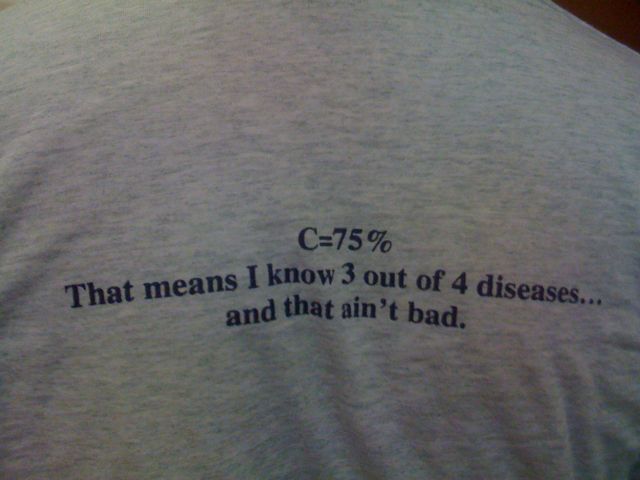
Medicine, though always seen as a rigorous field that only the smartest and strongest make it through, is actually a very formulaic process of which the hardest part is probably getting into medical school. A few often repeated axioms in medical school are: "What do you call someone who graduated last in their med school? Answer: A doctor" and "C = MD". Of all entering US medical students, 96% eventually graduate with a medical degree (in comparison, the same measure for graduate students in 62%). Most who fail to graduate, drop out of medical school for personal reasons, not because they were not qualified. Of those that graduate who want to practice medicine, all eventually find a residency program. With residency, it's a similar pattern. It is rare, but residents can be kicked out of their program. However, most find another residency program that is willing to take them. There are boards exams, but in many fields you don't need to be board certified to take care of patients, the pass rates are high and you can take them repeatedly until you pass. Of course, once you complete residency, even outright fraud or criminal negligence doesn't necessarily get your medical license taken away from you (I'm looking at you doctors who only serve as a prescription mill for narcotics).
The point here is that once you get into medical school, there is very little stopping you from eventually being a practicing physician. There are several problems. One is that there is a shortage of physicians out there and in many fields, such as family practice and internal medicine, there is a large number of open spots that need to be filled. A second problem is that medical schools and residencies thrive on their reputations. If their graduation rates decrease due to failure of a student or resident, it affects their statistics and makes the program less appealing to future applicants. Finally, there is a culture of avoiding confrontation in medicine. It's easier to pass someone than to deal with the trouble of remediation or removing the person from the program.
Please don't get me wrong. A vast majority of my coworkers and, likely, residents in other hospitals, are fine physicians who will serve their patient's well. However, the culture of passing everyone through the system, even if they are unqualified, has got to go. Patient's lives should be of primary concern.
Friday, June 17, 2011
Setting up shop in a parking lot
So, after a crazy month, I officially have my MD and have moved to where I will spend my intern year. I'm excited (and scared) for it to start. Orientation is next week, I'm sure you'll hear about it.
In the meanwhile, Mrs. mxh has started her job as a pharmacist. She works one day a week at a pharmacy in a sketchy part of town and it turns out that the doctors there are more sketchy than the patients. There are a few doctors in that part of town that are notorious for prescribing large amount of narcotics, a lot of the times without even seeing the patients. The only thing that comes out of their primary care clinics is narcotics prescriptions and their patients have a suspicious pattern of getting new prescriptions too soon. What really makes it bad, though, is that one of the doctors has a habit of just hanging out at the pharmacy and writing prescriptions for narcotics in the parking lot! Yikes! This isn't something new either, it's well known among pharmacists in the area. Why do these people still have jobs? Why isn't the state medical board stripping their licenses from them? Why aren't they arrested?
Part of the problem is that not too many people report them. But, I think, a major problem is that medical boards are notorious for not punishing their own. Medical schools emphasize fitting in and keeping the status quo. If you bring up a problem, it's better that it is discussed quietly. I think this attitude carries on to medical boards. If they punish a doctor, it'll make the news and that type of attention is something that medical boards don't like. If they ignore a problem, then everything will go an as it has. So far, it's been working, but some day, the narcotic ring that these two physicians are running will make front page news and the state medical board will wish that they have dealt with it sooner.
In the meanwhile, Mrs. mxh has started her job as a pharmacist. She works one day a week at a pharmacy in a sketchy part of town and it turns out that the doctors there are more sketchy than the patients. There are a few doctors in that part of town that are notorious for prescribing large amount of narcotics, a lot of the times without even seeing the patients. The only thing that comes out of their primary care clinics is narcotics prescriptions and their patients have a suspicious pattern of getting new prescriptions too soon. What really makes it bad, though, is that one of the doctors has a habit of just hanging out at the pharmacy and writing prescriptions for narcotics in the parking lot! Yikes! This isn't something new either, it's well known among pharmacists in the area. Why do these people still have jobs? Why isn't the state medical board stripping their licenses from them? Why aren't they arrested?
Part of the problem is that not too many people report them. But, I think, a major problem is that medical boards are notorious for not punishing their own. Medical schools emphasize fitting in and keeping the status quo. If you bring up a problem, it's better that it is discussed quietly. I think this attitude carries on to medical boards. If they punish a doctor, it'll make the news and that type of attention is something that medical boards don't like. If they ignore a problem, then everything will go an as it has. So far, it's been working, but some day, the narcotic ring that these two physicians are running will make front page news and the state medical board will wish that they have dealt with it sooner.
Subscribe to:
Posts (Atom)