Saturday, May 19, 2012

Delta Airlines doesn't want my business

A few days ago, John Stewart had a piece on the "War on Women" and showed a graphic of a nativity scene in between a woman's legs (the "vagina manger"). Bill Donohue, the head of the Catholic League, nearly had a heart attack and demanded from the sponsors of The Daily Show to pull their ads. Delta Airlines decided that one religious person's point of view is more important than that of others and pulled their ads. I, a Delta frequent flyer (even had status with them last year), didn't like the company giving into one religious person's point of view and let them know my feelings. What I got back was less than satisfying:

We’re always reevaluating our advertising opportunities and updating our strategy in an effort to reach our desired audience.  Most importantly I want you to know, Delta culture is one of inclusiveness and we do not discriminate nor do we condone discrimination in regard to age, race, nationality, sexual orientation, religion or gender.  As a global airline, Delta has historically been very committed to diversity and we are proud to embrace diverse people, thinking, and styles. Our commitment to diversity is highlighted on delta.com:

 Looks like Delta's policies don't exactly match Delta's actions. They just chose to side with a religious nut rather than embrace the inclusiveness that they strive for. They decided that the religion, thinking and style of Bill Donohue is more important than that of John Stewart, The Daily Show and their audience. Sorry, Delta... you've lost my business (and got added to the list).


Monday, May 14, 2012

Hospitalists

  This month I'm working on a cardiology consulting team and with it, I've gotten a lot of exposure to the hospitalist side of internal medicine. Hospitalists are internal medicine physicians who only take care of patients in the hospital. They have no clinics and only deal with the short-term problems that the patient is hospitalized for. In effect, they do my internal medicine rotation all the time (except they are the entire team). It sounds terrible. One colleague called it "residency for life." However, it has it's benefits. It is essentially shift-work, so it has a pretty nice schedule. Most people go into it straight out of residency (so only 3 years after finishing medical school). Most hospitalists work a week on followed by a week off. So, a vacation every other week. They also get paid pretty well. 200000+ for working a total of 6 months each year. Because of these benefits, it's quickly becoming a popular choice.
  The problem comes with not having ownership of the patients. Without any continuity of care, hospitalists don't know their patients as well as internists who also have a primary care clinic. With the shift-work schedule, their is a lot of passing patients between hospitalists and resulting poor communication. Also, with 20+ patients a day, there isn't much time spent with each individual patient. Putting all this together, hospitalists tend to not think about each individual case as much. At least that's the trend I've seen when consulting for a hospitalist versus consulting for a resident-run team or a team run by a regular internist. This doesn't mean that patients under the care of a hospitalist are at risk. The more common result is that they are overtested and specialists are overconsulted. If you don't have time to think about why someone is having chest pain, you get a chest X-ray, CT-scan, EKG, an echocardiogram, stress test and lots of blood tests and you consult a pulmonologist and a cardiologist. One of these will figure out what the problem is and your specialists will tell you what to do about it. I've seen this pattern quite a bit recently, including one case in which the hospitalist ordered these tests and consults prior to seeing the patients or even reading their previous notes (the patient was transferred from another hospital and through testing had already shown that his heart was fine).
  Of course, there are great hospitalists who know their patients well, think hard about each of the cases and use hospital resources efficiently. However, there is a disturbing number who are wasting resources and their consultants time as well as running up the cost of healthcare.

Sunday, May 6, 2012

A dangerous doctor

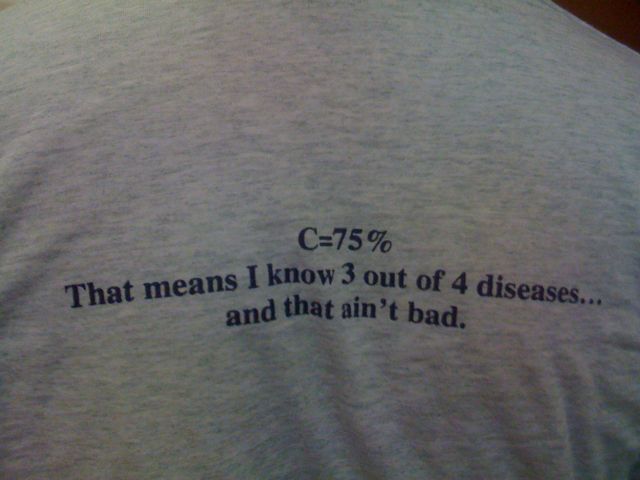
 C = M.D.

  I am doing my internship at a community hospital that mixes graduates from US allopathic schools (MD), US osteopathic schools (DO), American graduates from Caribbean medical schools and international graduates. Having worked with graduates from each of various programs, I knew, going in that a resident's background does not necessarily translate to their performance in the hospital. However, taking all the interns together, there definitely are some that are better than others, and there are a few that really should not be a doctor. For example, I worked with an intern who would like to become a cardiologist. He was asked to draw a heart and he simply did not know how the heart was organized. Not even close. When asked how he would treat someone with a complete heart block, he answered beta-blocker (which would kill the patient). If it was the beginning of the year, I could forgive him. If it was a one-time mistake, I could forgive him. But, this is someone who repeatedly shows that he has no clue how to treat patients. What's worse is that he actually thinks he knows it all. He manages patients without informing anyone of his actions (interns typically have senior residents or attending physicians to report to), because "it's an easy case" (Thank you, nurses, for catching his mistakes over and over again). He has been repeatedly corrected, but continues to make the same mistakes and even once uttering that the person correcting him "has no clue." He plagiarizes notes or writes notes and comes up with treatments without actually seeing the patient. This is a dangerous person. He has been caught and given chance after chance, but continues to make the same mistakes. Unfortunately, there is nothing stopping him and he will be a senior resident in a few short weeks.

  Medicine, though always seen as a rigorous field that only the smartest and strongest make it through, is actually a very formulaic process of which the hardest part is probably getting into medical school. A few often repeated axioms in medical school are: "What do you call someone who graduated last in their med school? Answer: A doctor" and "C = MD". Of all entering US medical students, 96% eventually graduate with a medical degree (in comparison, the same measure for graduate students in 62%). Most who fail to graduate, drop out of medical school for personal reasons, not because they were not qualified. Of those that graduate who want to practice medicine, all eventually find a residency program. With residency, it's a similar pattern. It is rare, but residents can be kicked out of their program. However, most find another residency program that is willing to take them. There are boards exams, but in many fields you don't need to be board certified to take care of patients, the pass rates are high and you can take them repeatedly until you pass. Of course, once you complete residency, even outright fraud or criminal negligence doesn't necessarily get your medical license taken away from you (I'm looking at you doctors who only serve as a prescription mill for narcotics).

  The point here is that once you get into medical school, there is very little stopping you from eventually being a practicing physician. There are several problems. One is that there is a shortage of physicians out there and in many fields, such as family practice and internal medicine, there is a large number of open spots that need to be filled. A second problem is that medical schools and residencies thrive on their reputations. If their graduation rates decrease due to failure of a student or resident, it affects their statistics and makes the program less appealing to future applicants. Finally, there is a culture of avoiding confrontation in medicine. It's easier to pass someone than to deal with the trouble of remediation or removing the person from the program.
Please don't get me wrong. A vast majority of my coworkers and, likely, residents in other hospitals, are fine physicians who will serve their patient's well. However, the culture of passing everyone through the system, even if they are unqualified, has got to go. Patient's lives should be of primary concern.

Tuesday, April 10, 2012

Dental X-rays: Not without risk

  Last year, I was at a routine dental visit when my dentist said that it's time to get an X-ray. Remembering that I had an X-ray in my last visit 6 months ago, I asked why? He said that my insurance allows a panorex scan every few years and that I am now eligible for one again. Upset that the insurance company gets to decide when I need an X-ray. I asked why I need a panorex when I just had regular X-rays last time. He said that it helps diagnosed other abnormalities not picked up on regular X-rays. When I asked what other abnormalities, he said, "Oh, lots. For example, we could find a bone tumor. We don't want to miss that." Knowing that bone tumors are pretty rare, especially in the face, I declined.
  I am glad I did. This study finds a link between dental X-rays and meningiomas (a benign, but sometime hard to treat type of brain tumor). It's a case-control study, so not the strongest type of study, but it's not surprising. X-rays are radiation. Radiation damages DNA, which can lead to cancer. X-rays as a screening test carry a risk. A pretty small risk, but a risk nonetheless. So, if X-rays are being used as a screening test in asymptomatic individuals, the disease they detect should be 1) common and 2) easier to treat if caught earlier. Breast cancer is an example of a disease that fits this descriptions, and breast X-rays (mammograms) are worth using as a screening tool. Maxillary or mandibular bone cancers are rare. Very rare. The cost and risks of X-rays do not justify their use as a screening tool. Just because the insurance company allows something, it doesn't mean that it should be used.
  Dentists are well aware of the fact that their frequent X-rays are unnecessary in the vast majority of their patients. Their patients don't know that. It's an easy way to make money and it's criminal that it is common practice. So, unless you've got symptoms, it's not worth getting frequent dental X-rays.

Monday, February 6, 2012

Drug Shortages

  These drug shortages are seriously affecting patient care for me. It's criminal. There's a good summary of why it's going on here. In 2005 there were 61 drug shortages, in 2011 there were 267 and the list is growing. These aren't obscure drugs that rarely get used. They are common drugs that we use all the time. That we need to use all the time. dilaudid, fentanyl, morphine, midazolam, diazepam, lorazepam, propofol (really?), ondansetron, promethazine, succinylcholine, rocuronium, heparin (!), lidocaine, labetalol, hydralazine, norepinepherine (there are only a few pressors and this is the one we most commonly use!), to name a few. The hospital keeps on telling us to use less of them, but for many, there just isn't a good alternative.

There are a lot of possible reasons why this is happening. With few or, often, one company manufacturing many of these drugs, any production delay, violation of regulations, shipping problems, etc. can lead to a shortage. Being more cynical, I would say a major factor is that these generic medications have no money in them. However, with drug shortages, semi-legal middle-men hoard them, then sell them to hospitals at outrageous costs (up to 800-1000% mark up in price). For example, here's what happened with erythromycin ointment (used in babies!): "All of a sudden, it went short with no notice," Culligan said. "We were able to scramble and secure our supply." Not all hospitals were so lucky; the drug was off the market for a few months. "When it came [back to market], it went from 50 cents to $8 a tube."

 It hurts patient care tremendously and hospitals are forced to buy these drugs from (essentially) the black market. Especially because "manufacturers either routinely don't provide any notice of an impending drug shortage or provide little advance notice and no estimate of the projected duration." (because I'm sure they want it to last forever).

It is inhumane and it is criminal. The FDA is trying to go after them, but they have limited authority and I'm sure they'll get nowhere. They are merely "asking them to increase production, if possible [pretty please], in order to prevent or reduce the impact of a shortage." Our healthcare system is broken in many ways, but this is something that the government needs to take care of quickly. There's are many reasons why we lag behind the rest of the world in health care measures despite having access to the most advanced care in the world and greed from pharmaceutical manufacturers should not be one of them.

Tuesday, January 31, 2012

Unnecessary medical procedures

There are international laws against unnecessary medical procedures, but the nuts who run this country are trying to push for exactly that in many states to try to punish women who get abortions. The latest is Virginia who is about to pass a law requiring women to get pre-abortion ultrasounds. It's all to provide just another hurdle for women to go through to have a legal medical procedure. It makes it more difficult and more expensive for women. The heartless idiots who propose such bills, like State Sen. Jill Vogel, lie through their teeth and say things like:

"I view this as a serious women's health issue," Vogel said on her website. "At a minimum, ultrasound is necessary to determine gestational age and that there is no anomaly that could affect the health of the mother or outcome of the procedure."

First of all, State Sen. Jill Vogel... you're not a doctor, so you have no qualifications to make such a statement. Can you tell me what possible anomalies you're looking for? Second, you're lying, plain and simple. You want women to go through this unnecessary medical procedure because you want to make it difficult for women to get abortions, or at best you think that seeing their baby on ultrasound will get women to change their minds.

A second bill that will sail through Virginia's mentally challenged legislation is even more heartless. State Del. Mark Cole "would eliminate that financial support even when a doctor believes an unborn child would be born with a gross and totally incapacitating physical deformity or mental deficiency." This goes beyond just pro-life and pro-choice. People supporting this bill, which constitute a majority of Virginia's house and senate, are just plain psychopaths. I just don't see it any other way. The only thing such a bill results in is to force the mother to go through hell and force the baby to live a few miserable hours to weeks in excruciating pain or discomfort.

Just when I don't think the right can stoop any lower, they keep on proving me wrong.

The only thing Virginia has going for it is State Sen. Janel Howell who "tried to amend it so men seeking prescriptions for erectile dysfunction medication such as Viagra would be required to undergo a rectal exam and cardiac stress test."


She said that's "only fair, that if we're going to subject women to unnecessary procedures, and we're going to subject doctors to having to do things that they don't think is medically advisory."
 
 (might I suggest transrectal ultrasounds before prescribing ED drugs?)

Of course, as expected, right-winged psychopaths voted it down.

As someone who will have to read ultrasounds in the near future, I would rather give up my career than be forced to interpret the results of an unnecessary medical procedure that the government forces onto it's citizens.

Thursday, January 19, 2012

This is why I don't like religion and everyday business mixing

Jessica Ahlquist is a teenager who fought against blatant display of religion in her public school. She won, with the court finding those displays unconstitutional (it's sad that you even have to take someone to court about something as clear cut as that). Now, her community is treating her like a second class citizen. Freedom From Religion Foundation wanted to send her flowers and not one of the four florists in Cranston, RI wanted to deliver to her. Somehow your religious views make it ok for you to not do your job (and discriminate against others). These 4 florists have been added to the list: Twins Florist, Floral Express, Flowers by Santilli and Greenwood Flower.