OK, now that I'm nearly a year out from becoming a doctor, I've gotten a chance to be on the other end of medical school for long enough to try to give some advice to those going through medical school now. I've worked with several medical students and have picked up a few things about what makes a medical student a successful member of the team.
1. Get to know your patients. You have more time than everyone else on the team. So, get to know your few patients as well as you can. First, it's an interesting experience and you'll build a great relationship with the patient. You'll gain the patient's trust and may be able to get more information from the patient than any resident or attending will. With this, you'll add to the patient's care more than any resident will. I've seen patients specifically asking to see the med student rather than the resident or attending because of the close relationship they've built.
2. Think for yourself. Come up with a plan of what you want to do right after you see the patient and before you talk it over with a resident or attending. Don't worry about being wrong. It will quickly help you figure out how different conditions are tested and treated.
3. Do your work. Don't copy the work of others. I know that med student notes are usually ignored by everyone, but it's something you need to learn to do on your own since you'll be using it for the rest of your life. I've seen several med students directly copy notes from residents... not cool and not unnoticed.
4. Don't make your teammates look bad. This includes pimping your residents, showing off about what you know or have learned or volunteering for more than what is expected of you. A medical student I worked with volunteered to give a presentation during our medicine rotation. No one asked anyone to give a presentation, but he thought he'd look eager and interested if he volunteered out of his own initiative. It backfired terribly. Even if the talk had gone well, it upset the residents because it took time out of the day and it made the other medical students look bad and feel that they need to do the same thing. Kissing ass can get you far in med school, but it can also terribly backfire, so better to not do it.
5. Ask questions. There are no stupid questions. Lots of what you have questions about, other, more senior team members probably also have questions about.
6. Don't pretend you're going into the field of whoever you're talking to. They'll see right through you.
7. There are some things you should not emulate. Interns will complain. They will bitch. They will make fun of attendings, patients, each other. They will slack off. You cannot do that. Despite all the complaining and slacking, they will get their work done. You just started, you have a lot of studying to do and can't afford to waste time like they do.
8. Don't lie. If you forgot to look something up or didn't get a chance to see a patient, don't make up numbers or a physical exam. There was a medical student who forgot to pre-round on one of his patients and just made of the physical exam (it was a surgery rotation, so he was actually pretty close to being right). He got caught when he went to the patients room and didn't realize that the patient had moved to a different part of the hospital the night before.
9. Don't be scared, upset or angry about criticisms you hear from others. Think about it. If it's justified, learn from it. Don't take it personally. Don't think it'll ruin your grade.
I'm sure there is more, but these are the ones that jumped at me with the med students I worked with in the last year.
Showing posts with label med school. Show all posts
Showing posts with label med school. Show all posts
Tuesday, June 5, 2012

Sunday, May 6, 2012
A dangerous doctor
C = M.D.
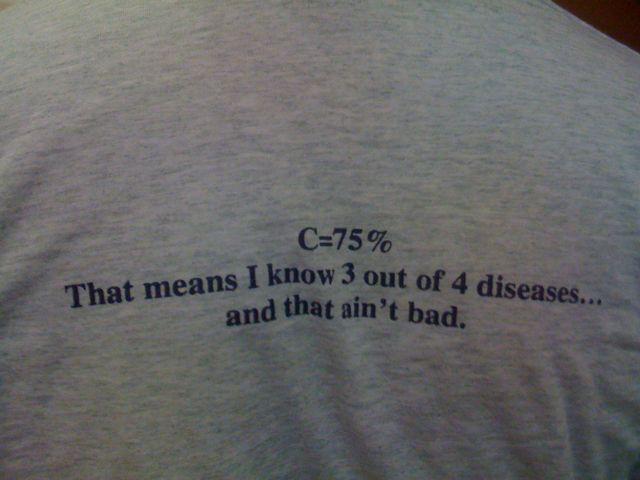
Medicine, though always seen as a rigorous field that only the smartest and strongest make it through, is actually a very formulaic process of which the hardest part is probably getting into medical school. A few often repeated axioms in medical school are: "What do you call someone who graduated last in their med school? Answer: A doctor" and "C = MD". Of all entering US medical students, 96% eventually graduate with a medical degree (in comparison, the same measure for graduate students in 62%). Most who fail to graduate, drop out of medical school for personal reasons, not because they were not qualified. Of those that graduate who want to practice medicine, all eventually find a residency program. With residency, it's a similar pattern. It is rare, but residents can be kicked out of their program. However, most find another residency program that is willing to take them. There are boards exams, but in many fields you don't need to be board certified to take care of patients, the pass rates are high and you can take them repeatedly until you pass. Of course, once you complete residency, even outright fraud or criminal negligence doesn't necessarily get your medical license taken away from you (I'm looking at you doctors who only serve as a prescription mill for narcotics).
The point here is that once you get into medical school, there is very little stopping you from eventually being a practicing physician. There are several problems. One is that there is a shortage of physicians out there and in many fields, such as family practice and internal medicine, there is a large number of open spots that need to be filled. A second problem is that medical schools and residencies thrive on their reputations. If their graduation rates decrease due to failure of a student or resident, it affects their statistics and makes the program less appealing to future applicants. Finally, there is a culture of avoiding confrontation in medicine. It's easier to pass someone than to deal with the trouble of remediation or removing the person from the program.
Please don't get me wrong. A vast majority of my coworkers and, likely, residents in other hospitals, are fine physicians who will serve their patient's well. However, the culture of passing everyone through the system, even if they are unqualified, has got to go. Patient's lives should be of primary concern.
Friday, February 4, 2011
Looking back at the match process

OK, so we're finally getting towards the end of this crazy "match" process to get into a residency program. I think I've got my rank list down and I'll find out where I end up in March. Now that I've got about a month to wait, I could reflect back on the process. Here are some general thoughts:
1. Interviews
Interviews were a lot of fun and, at least in radiology, almost completely stress free. Those interview preparation questions that the school provided us with were pretty much useless. The conversation-like interviews I had with faculty really helped me get to know a program and helped me let them know the kind of person I am. The few "standard" interviews I had were very awkward for both parties and probably not very helpful for either (especially, the one where one faculty member was interviewing two applicants at once). Some quick points: At first I started reading about the faculty at the institution, but I gave up on it pretty quickly. I never had to bring it up and the casual conversations we were having were much better. Buying and carrying a leather portfolio was useless. I never had to pull out a CV or research paper. I lost it half-way through the interview process and never bothered getting another one. There will be "illegal" questions (especially, "where else are you applying?"). I also once got asked what religion I was ("none" was the response, in case you were wondering).
2. Traveling
Holy crap this is expensive. I went to 10 radiology interviews and 9 intern year interviews. Some I drove to, some I flew to. A few places provided a hotel room, most didn't. I kept track of the total cost and I just hit $3000. Add to that the application fees and it gets close to $4000. That's why most people take a loan. A couple of tips: Southwest is awesome (cheap, free bags, can cancel/change without a penalty; it doesn't get better). Renting a car is often cheaper than taking cabs everywhere and it gives you a chance to explore the town. Signing up for frequent flyer and hotel loyalty programs pays off, even if you end up not using the points. I got nice hotel upgrades and free perks (drinks, snacks, higher floor) just because I attached a number to my name. Trying to cluster all the interviews in one region together is nice, but will probably end up to be impossible. TSA sucks, though, I found out that if you freeze your liquids, you can take more than 3 ounces.
3. Research experience
With 10 years of research under my belt, I thought I'd get most questions about my work. Unfortunately, most radiology programs don't care about it (some even see it as a liability in residents). They just want you to check off that box. For example, a top-tier program that has amazing research claimed that all their residents complete a research project during their stay. When I asked how much research time they get, the answer was "7 days a year" (really? It takes me 7 days just to pick a background for my computer station). Something like 75 to 80% of radiology residents go into private practice, so it doesn't matter to them. However, it really hurts the field. With procedures and image interpretation being constantly taken away from radiologists by other fields (cardiologists read echos, vascular surgeons do interventional procedures, ER physicians perform and interpret their own ultrasounds), the future of radiology as a field depends on innovation. When research is shunned by training programs, the innovation will be taken by other departments also.
4. Intern year
So useless. From every radiologist I've heard that it has had no impact on their ability to be an effective radiologist. I applied to lots of intern year programs (some easy, some tough) so that I could live in the same city for both intern year and the radiology years, but it's unlikely that I'll be able to pull it off. That's OK, though. A brilliant comment I heard from a resident was "It's better to lose a weekend moving than to lose every weekend because you chose a tough intern year so that you could stay in the same city." I got some great intern year interviews, but if I could do it again, I wouldn't take location into consideration.
5. Rank lists
People really talk as if there's a strategy to it. There is none, just put the programs in order of your preference. It makes no difference if your number one is a long shot.
6. It's a big game.
By that, I mean that there are specific things that you should do to get an interview or to be considered for a position. These things have no relation to your strength as an applicant, but if you don't do it, your chances at matching may be hurt. For example, there are letters of interest, sending thank-you notes, sending "love letters". Towards the end of November or early December comes a point when you start getting worried about the number of interviews you've gotten and you haven't heard from some of your favorite places. At this point, sending a letter of interest can get you an interview. It really makes no sense (I mean, you applied there, so you're interested, right?), but it makes a big difference to some people. I've heard of a program where they won't interview anyone who doesn't send a letter of interest. I suppose it's to separate people who really want to go to the program from those that are applying to every program in the country (it happens), but if there's an unspoken rule that you must send a letter of interest (after actually applying) to be considered by a program, you might as well make it part of the application process. "Love letters" can go either way. Applicants can tell a program that they will be ranking that program first and programs can tell applicants they are raking them high. What either party says, however, from what I've heard, means absolutely nothing. Programs want to tell lots of applicants that they're ranking them high to get applicants to rank them high, so they can brag about getting their first choices. ... I could go on and on about this, but suffice it to say that the whole process leaves me with a bad taste in my mouth.
7. Med school
It falls to the background. There is no way I'd be able to go to all these interviews and still be on a clerkship. I'm glad I set up my schedule to maximize my time off during 4th year. Speaking of 4th year, the great thing about it is that pretty much everything is self-run. Your grade doesn't matter anymore, so it's all for fun and interest. The bad thing is that, unless you want to have a horrific 3rd year-like schedule, it consists of an awful lot of shadowing. It makes you burn out pretty quickly. Oh well, only a few more months.
Friday, October 8, 2010
Checking email
Still checking my email for possible residency interviews. It's a very anxiety-provoking process. I check my email something like 20 times a day (I thought having a smart phone would be great, but it turns out to distract me more than help me). It's getting to be a crazy obsession. The plus side is that I've gotten two radiology interviews and four intern year interviews. It's somewhat reassuring, but it hasn't stopped the anxiety (and I did get one rejection from an intern year program).
One thing I'm really glad I managed to do was to take a large chunk of time off in December and January (prime interview season). With the number of interviews I hope to get (and an equivalent number of intern year interviews since I want to be in the same city for both), I will be traveling all the time. Our school only lets us take off one day per week of class for interviews and (by my calculations) I would have to break that rule to fit in the number of interviews I hope to get. Some classmates who don't have the time off are wondering how to deal with this dilemma. Since the med school administration always strictly adheres to their rules (and no amount of logic will let them change it), the best option is to either call in sick or ask your resident/attending and not bother with the administration. Nonetheless, the administration may find out and you'd have to deal with their fury.
Tips to any future medical student:
1. It's best to plow through 3rd year and free up 4th year for easy rotations/research/time off so that you could focus more on residency applications and interviews.
2. When it comes to needing time off, follow the old adage: It's better to take the time off and apologize afterwords than to ask for permission and not get it (because you won't get it).
Tuesday, June 29, 2010
USMLE Step 2 CS: A waste of $1000
I recently took the clinical skills (CS) portion of step 2 of the US medical licensing exam (USMLE). It's a whole day of interviewing standardized patients (actors), writing notes, coming up with possible diagnoses and ordering lab tests. It definitely covers what every physician should know. What's upsetting though, is that it's a recently-introduced exam that costs $1295 and has a 96% pass rate (and supposedly 100% at our institution). So essentially, every medical student in the country (something like 15,000 students each year) has to take the exam so that only 600 (most of whom probably also have terrible grades and are unlikely to match into a residency program anyway) could be weeded out. We live in a culture of standardized testing. There are whole industries surrounding it (books, tutoring, computer programs, testing centers, patient actors, etc.). So, its not surprising that the company administering the medical licensing exam would like to add yet another exam for students to take. What's disappointing is that physicians in charge of medical licensing go along with it. Residency programs don't care about your Step 2 CS score and I highly doubt that there will be less dangerous physicians around because of this new exam. My cynical opinion is that someone decided that they could make an extra $20 million each year off of medical students and "convinced" those in charge of medical licensing to go along with it.
Oh well, at least I'll never have to deal with fake patients anymore.
Thursday, May 20, 2010
4th year will be sweet
Just about done scheduling 4th year and it looks like it'll be nice. Right now I actually have 22 weeks off! Of course some it will be taken up by taking the boards and interviewing for residencies, as well as research (and maybe I'll add a few more rotations later on), but it sure will be less hectic than 3rd year has been. What I'm really excited about is the end of working for grades, good evaluations, exams, busy work, etc... I will finally (with few exceptions) be able to spend 100% of my time in the hospital on learning what I am interested in. I kind of wish all of med school was like that.
Monday, April 19, 2010
Taking Oaths
I thought that the only oath I'd be taking in med school is the Hippocratic oath. But, in more than one rotation, I've had to sign papers that certified that I really did read the reading I was assigned or watched the video I was assigned. It's frustrating on two levels. One is that I find oaths in general kind of useless. If someone is going to do something wrong or illegal, they're not going to have much of a problem lying about it. What's more upsetting though is the paternalistic approach that medical schools have towards their students. If there is a reading or video that is recommended, it should be up to me to decide whether I think it's useful to my education. If I don't find it useful, actually doing the assignment will only waste my time. I believe that we're mature enough to decide what the best way for us to study is. I've had hundreds of exams and know pretty well what works for me. The school shouldn't care (and shouldn't make me sign oaths) that I didn't do a particular assignment.
Of course, the administrators don't really remember being students, so they've implemented things like quizzes that ask questions about topics that were in the readings, but not exactly important to clinical practice or (rumor has it) actually make sure that you've clicked on and watched the entire 26 minutes and 13 seconds of the video that is posted on line. This is what happens when you lose sight of priorities... so, if you'll excuse me, I've got to play another video at 2X speed with the sound muted in the background.
Monday, March 8, 2010
4 Stages of a 3rd year med school rotation
1. Confusion: You don't know when to be where. You don't know what you're supposed to do, what you're allowed to do, and what you can't touch. You don't know the right terms for anything. You don't know who to talk to. You don't know where the patients are. You don't know when to leave.
2. Productivity: You got the logistics down. You've gotten to know how the system works. You're actually being useful to the team. You're actually learning from your patients. You know when to go home without asking.
3. Burn out: You're getting tired of the routine. You're getting tired of the busy work. You're less excited about the day. There are less learning opportunities during the day. You look forward to going home.
4. Numbness: Your mind is elsewhere and your goal is to just get through the day. Unless something really exciting happens, you're not gaining much from the rotation. You find ways to get out early.
This is kind of a tongue-in-cheek thing, but for some rotations it's definitely true.
Friday, February 26, 2010
How not to treat your students #3
Another one for the series.
I know the resident has more important things to think about, but med students really, really appreciate it when someone keeps them in the loop (especially when they say they're going to).
Resident: You guys can do whatever. But stay in the hospital. We're getting an interesting patient soon. I'll page you guys when she gets here
Students: OK, thanks.
5 hours later, no page... students page the resident... no response, students go home
The next day:
Student: Did the patient get here yesterday?
Resident: Oh yeah, she cam at one (2 hours after he said he'll page us).
Student: Did you get my page?
Resident: Yeah, I already took care of the patient by then.
I know the resident has more important things to think about, but med students really, really appreciate it when someone keeps them in the loop (especially when they say they're going to).
Monday, February 15, 2010
How not to treat your students #2
I was talking with a few students in the hallway when a resident, who was in no particular hurry, walked down the hallway and literally pushed us away while saying "Outta the way kiddos!"
WTF? Just because you have an MD doesn't make you any more worthy of the hallways than us. (I replied with "Kiddos? I'm probably older than you!")
Later that week we were all sitting in a room with other residents and attendings, when the same resident walked into the room and said, "Med students, get out of your chairs. I need to work." Granted she may have been doing some important work, but she could treat the students like human beings and ask nicely, rather than ordering us to give up our seats as if we're second class citizens.
There are lots of simple things that residents and attendings could do to make med students enjoy their time in the hospital better. The easiest one is to treat them like normal human beings. I hope I'll treat my students better.
Sunday, February 7, 2010
How not to treat your students
I recently worked with an attending who completely ignored my presence. Not too unusual in med school. But,I got pretty upset when the attending responded to every question I asked by turning to the resident and replying to him. He didn't want to stoop so low as to talk to a med student. Arrogant ass.
Wednesday, July 29, 2009
Equal education?
Throughout third and fourth year of med school, students work with a team of residents and attending physicians either alone or with another med student. At least in internal medicine, each student has his/her own patients and reads up on and follows those patients. Different teams may specialize in different types of patients and even within a single group, the types of patients followed by one student (by chance) could end up being very different from those followed by the other. This leads to a lot of variability in what each student learns from their experience on the rotation. For example, most of the patients that I've followed in my internal medicine rotation so far have had liver disease or a bile duct/gall bladder problem. I've read up on these conditions a lot and think that I'd do a pretty good job at examining, diagnosing and treating a patient with these disorders. But other students on the rotation with me have completely different patients, some have more cardiology patients, others have more kidney patients, and each (I assume) are more familiar with those conditions than I am. I hope that it evens out soon... these practice questions that I've been doing for the final exam really shows the bias in my experience with patients. I switch teams (and hospitals... and cities) next week, so I hope to get some exposure to the type of patients that I haven't gotten a chance to see yet.
btw... (can't believe it's already been a month, only 22 more to go).
Saturday, July 11, 2009
72 hrs later
So, as I mentioned before, we were told that we'd feel a bit more comfortable about starting the wards 72 hrs into it. Well, I just got back from my 3rd day in the wards and I do feel a bit more comfortable. I've figured out the basics of the computer system and I've gotten a little bit better with rounding, presenting patients and writing notes on my patients. So, after 72 hrs here's my impression on internal medicine (and maybe being a 3rd year med student as a whole):
1. Getting to be where the action is.
Yeah, I don't get to actually do much, but each day I do get to closely follow a team of doctors debate and make many potentially life-altering decisions on several people.
2. Applying all that medical knowledge to real people
I finally see how many of those lists and seemingly endless facts finally make some sense. I'm far from being comfortable with them, but at least I get to see them applied to real life. And, applying it to real life goes a long way to putting those facts in memory. For example, knowing that low platelets can be an effect of liver failure is much easier when you've seen that Mr. X, your patient with liver failure needs to get a platelet transfusion before every procedure.
3. Talking to patients
This is actually the most satisfying part of going into the hospital. I get to spend some extra time with my patients and actually get to know them. They're pretty bored and enjoy talking to me. I feel that by spending more time with them, I get to better understand their expectations, fears and frustrations. It never ceases to amaze me how honored I feel when a stranger opens up to me and tells me everything about them.
1. I'm useless.
I get to be part of a team of physicians that help make a very sick person well again, but I am completely useless. As a medical student, almost nothing I do has any consequence on the patient's stay, and the few things I get to help with, the team really doesn't need my help. Sometimes I feel like I'm in the way. The only part that makes me feel like I'm actually having an effect is when I get to relay the patient's concerns to the doctors because I get to spend more time with them (see the goods).
2. I don't know anything
This may be specific to me since I took 4 years off between finishing 2nd year of med school and starting 3rd year. I've forgotten a lot of facts. Everyone around me is nice and I haven't pimped at all, but the really easy questions that I get, I still have trouble answering. It hasn't all come back to me yet, but then again it's only been 3 days.
3. Studying
Along the lines as #2 and also specific to the fact that I took 4 years off. I've had no reason to memorize lists of facts in the last 4 years and I haven't bothered finding a good way to do it. I remember at one point in the second year of med school, I would learn the pathophysiology of an entire organ system in a week or so before the final exam. Now, I don't even know where to begin. I'm hoping this comes back to me also.
4. Of course, the hours
No matter what, I can't get used to getting up at 5 am (or before) every day. I've gotta learn to sleep earlier.
In all likelihood, these opinions will change in another 72 hours. Overall, I like internal medicine so far. I'm learning a lot and it's not completely exhausting (yet). We'll see how I feel about it as I get more into it. Stay tuned.
The goods (in no particular order):
1. Getting to be where the action is.
Yeah, I don't get to actually do much, but each day I do get to closely follow a team of doctors debate and make many potentially life-altering decisions on several people.
2. Applying all that medical knowledge to real people
I finally see how many of those lists and seemingly endless facts finally make some sense. I'm far from being comfortable with them, but at least I get to see them applied to real life. And, applying it to real life goes a long way to putting those facts in memory. For example, knowing that low platelets can be an effect of liver failure is much easier when you've seen that Mr. X, your patient with liver failure needs to get a platelet transfusion before every procedure.
3. Talking to patients
This is actually the most satisfying part of going into the hospital. I get to spend some extra time with my patients and actually get to know them. They're pretty bored and enjoy talking to me. I feel that by spending more time with them, I get to better understand their expectations, fears and frustrations. It never ceases to amaze me how honored I feel when a stranger opens up to me and tells me everything about them.
The bads (in no particular order):
1. I'm useless.
I get to be part of a team of physicians that help make a very sick person well again, but I am completely useless. As a medical student, almost nothing I do has any consequence on the patient's stay, and the few things I get to help with, the team really doesn't need my help. Sometimes I feel like I'm in the way. The only part that makes me feel like I'm actually having an effect is when I get to relay the patient's concerns to the doctors because I get to spend more time with them (see the goods).
2. I don't know anything
This may be specific to me since I took 4 years off between finishing 2nd year of med school and starting 3rd year. I've forgotten a lot of facts. Everyone around me is nice and I haven't pimped at all, but the really easy questions that I get, I still have trouble answering. It hasn't all come back to me yet, but then again it's only been 3 days.
3. Studying
Along the lines as #2 and also specific to the fact that I took 4 years off. I've had no reason to memorize lists of facts in the last 4 years and I haven't bothered finding a good way to do it. I remember at one point in the second year of med school, I would learn the pathophysiology of an entire organ system in a week or so before the final exam. Now, I don't even know where to begin. I'm hoping this comes back to me also.
4. Of course, the hours
No matter what, I can't get used to getting up at 5 am (or before) every day. I've gotta learn to sleep earlier.
In all likelihood, these opinions will change in another 72 hours. Overall, I like internal medicine so far. I'm learning a lot and it's not completely exhausting (yet). We'll see how I feel about it as I get more into it. Stay tuned.
Tuesday, July 7, 2009
mfp
All right! 3rd year of med school officially started and with it, after another long orientation, I got my first patient. Unfortunately, because I showed up in the middle of the day, I had to pick up a patient who has already been in the hospital for weeks. This means going through a lot of charts (dozens per day, by various MDs, nurses, pharmacists, therapists, etc.) There are two problems with this: 1) I have no idea how to use the hospitals computer system and have to click around for several minutes before I can get to where I need to go. 2) So many abbreviations! I know that doctors like shorthand, but just with this one patient, there are a dozen abbreviations that I've never seen before. Some even have multiple meanings. I've figured a lot out from context: SBP = systolic blood pressure, but SBP treated with cefotaxime is spontaneous bacterial peritonitis... seems easy to figure out, but when your eyes are glazing over the 24th progress note, its easy to confuse the two. Others, I still have no idea... the google helps, but I'll just have to break down and ask someone about some of them tomorrow.
We were told that within 72 hours most of this will make sense, but I have a hard time believing that. We'll see. Meanwhile, I gotta figure out how I'm going to preround tomorrow morning (see the patient before the residents and attending physician does) and prepare myself to present my patient to the attending (focused, yet thorough - seems like an oxymoron to me).
mfp = my first patient
Monday, July 6, 2009
I am oriented (sort of)
It's finally here, the first day of third year. Today was orientation day... all day getting lectures about what to expect next year and how to survive through it. For the most part there was nothing eye-opening from the various lectures. A couple of things stood out. One was a discussion on how to get along with others in our "team" (attending physicians, residents, nurses, etc. that we are working with) and how to carry ourselves in the hospital. One administrator stated that we should remember the saying "When in Rome, do as the Romans do." To an extent, I agree with that, but not everyone in medicine provides a good example and we should judge for ourselves what is appropriate in a hospital setting and we shouldn't blindly imitate the attitudes and actions of those above us. (Luckily, another administrator quickly mentioned that we should also be a force of change to make the hospital a better place).
Along these lines, I was pleasantly surprised that the med school and hospital are largely aware that the environment of medical education isn't perfect and seem to be working to improve it. I wasn't surprised by the report (of med schools in general... not just mine) that abuse of students is fairly common. To deal with it, a recent addition to our school is the implementation of an on-line method to report inappropriate behavior or abuse by others in the hospital. The report goes to an ombudsperson who is not a physician and has no relationship with any medical department. Although it is sad that such a system is necessary, it's nice that a lowly student can bring inappropriate behavior to light without fear of reprisal by those above them (something several students I know who have gone through med school before me have complained of).
Anyway, enough with the bad stuff... Tomorrow is orientation for my first clinical rotation: internal medicine. I'm fairly excited to start (though not excited about the hours) and will hopefully be able to relate some of my experiences here (really, more for myself than my three faithful readers, but you guys might find it interesting also).
Friday, May 29, 2009
Returning back to med school (sort of)
Although I don't officially return to med school until July, I unofficially started med school this week. I couldn't fit a 2-week radiology rotation in my schedule during 3rd year, so I decided to do it now (since I have 6 weeks off and doing nothing). It's definitely a laid back med school rotation (yesterday, we were in at 9 - which is nearly lunch time for typical med school rotations and were done at 3) and there is no patient contact. However, it does give me a chance to assess how well I remember my facts from nearly 6 years ago. I am currently on the rotation with students who are ending their 3rd year, so they've nearly had a year of school, and as a result have experienced a lot and know a lot. But, besides the obscure disease that no one actually sees (except on the boards), so far, I've been able to hold my own (although, I guess I should wait until I see how I do on the exam before acting so cocky). Previous MD/PhDers have told me that it all comes back to you and I never believed them... but it does seem to come back pretty quickly (even anatomy). So, at the minimum this mini-rotation has helped me feel less anxious about the hard-core rotations that will come up soon (medicine and surgery are my first two).
But beyond that, it's made me realize that radiology is awesome! Since my research was somewhat radiology-related (I did use MRI's), it was a field I was always looking into. The fact that is has great hours, great flexibility, and (yeah, it's important) great salary, was really pushing me towards it. But without seeing much of it at work, I didn't really have a great reason to pursue it (other than research). Well, even though I've only had a few days of it, I'm much more impressed by the field. It really is a field that is very scientific. More than any other field, I think that the translation from basic research to clinical practice is the fastest in radiology. They already use techniques that are considered cutting edge (even for research purposes). Techniques that were discovered only a few years ago. I really like the fact that it has such a close relationship with the research side of things and the flexibility will make combining a life of research and clinical work very easy.
It's really early and I may change my mind, but so far, it looks like I'm going to continue telling people I want to go into radiology.
Thursday, April 2, 2009
Badmouthing the Med School
Over at Science-Based Medicine (great site), there is a post by a medical student about his/her concern with a mandatory assignment to a clinic that promotes alternative medicine (things like acupuncture to "control post-partum bleeding" and cupping). This is an unfortunate situation that is creeping into many medical schools (including mine). Dr. Gorski has a great response to the student (document everything, find other students/faculty members who feel the same, then make a formal complaint to the dean). One thing, though, that caught my eye was the following:
Is this legal? From the terrible experiences several med students I know have had, my plan, after returning to med school, is to document my experiences (good and bad) here, on this blog. If there's anything that the medical school does that may give it a bad reputation, they should fix it, rather than threaten their students and attempt to hide it from the public. I don't know what the official stance of my medical school is (and I don't plan on asking either), but I don't intend on holding much back.
Unfortunately, Student X informs me that the dean censors anything said by medical students on blogs or online forums that might bring the medical school into disrepute. Were I to name his medical school and it ever became known who had complained to me, the consequences are likely to be unpleasant.
Is this legal? From the terrible experiences several med students I know have had, my plan, after returning to med school, is to document my experiences (good and bad) here, on this blog. If there's anything that the medical school does that may give it a bad reputation, they should fix it, rather than threaten their students and attempt to hide it from the public. I don't know what the official stance of my medical school is (and I don't plan on asking either), but I don't intend on holding much back.
Wednesday, February 4, 2009
Oh no... quackery counts as medical education
Here's a recent "opportunity" from our medical school:
Now that (yet another) scientific review says that acupuncture is nothing but a glorified placebo effect (and I won't even bother with the rest), aren't there more important (more proven) medical techniques that medical students should be educated in? Does the medical school really think that spending an entire month (of the mere 18 months of clinical rotations that makes up an MD) on traditional (i.e. fake) medicine will really add to their students' educations? Come on medical educators... you can't teach your students about evidence-based medicine and then allow this to count as a month's worth of credit at the same time.
Traditional Chinese Medicine Rotation—Preliminary Announcement
I am pleased to announce that we are again able to offer a rotation in traditional Chinese Medicine (TCM) during the Spring of 2010. This month-long rotation is possible through the exchange program between the Department of Family Medicine and FuXing Hospital in Beijing. In addition to didactic instruction in the principles and techniques of TCM (acupuncture, massage, herbal treatment), students will observe how TCM is practiced in Chinese community health centers and hospitals. Limited hands-on training in acupuncture and/or massage may also be provided.
Now that (yet another) scientific review says that acupuncture is nothing but a glorified placebo effect (and I won't even bother with the rest), aren't there more important (more proven) medical techniques that medical students should be educated in? Does the medical school really think that spending an entire month (of the mere 18 months of clinical rotations that makes up an MD) on traditional (i.e. fake) medicine will really add to their students' educations? Come on medical educators... you can't teach your students about evidence-based medicine and then allow this to count as a month's worth of credit at the same time.
Subscribe to:
Posts (Atom)