Showing posts with label healthcare. Show all posts

Saturday, December 29, 2012

Hobby Lobby breaks the law

One of the first companies that was on my list of companies that mix religion and business, Hobby Lobby, and its sister company, Mardel, has decided to break the law for Jesus by refusing to cover birth control pills for their employees as required by the new healthcare law. The owner sued to government to be exempt from covering it because it violates the owners religious freedom. To which, luckily, the US district judge said, "Hobby Lobby and Mardel are not religious organizations."


That's right. By their logic, a company ran by a Jehova's witness should be exempt from covering blood transfusions and one run by a Christian Scientist should be exempt from providing any healthcare at all. The government has threatened to fine them $1.3 million a day if they refuse to comply with the law. The owner thinks he's being a hero and plans on not covering contraception. I really hope that the government follows through with their threat, because otherwise, thousands of other companies with religious nuts as owners will follow suit. Given the Obama administration's habit of giving into religious nuts, I'm afraid they'll let Hobby Lobby get away with it.

(Yes, it's been a while since my last post, but radiology is not as light as I expected it to be. More on that soon.)

Quick update: A federal district court allows another company ran by a religious nut to be exempt from covering birth control for their employees. The flood gates have opened. Expect hundreds of more challenges.

Monday, February 6, 2012

Drug Shortages

  These drug shortages are seriously affecting patient care for me. It's criminal. There's a good summary of why it's going on here. In 2005 there were 61 drug shortages, in 2011 there were 267 and the list is growing. These aren't obscure drugs that rarely get used. They are common drugs that we use all the time. That we need to use all the time. dilaudid, fentanyl, morphine, midazolam, diazepam, lorazepam, propofol (really?), ondansetron, promethazine, succinylcholine, rocuronium, heparin (!), lidocaine, labetalol, hydralazine, norepinepherine (there are only a few pressors and this is the one we most commonly use!), to name a few. The hospital keeps on telling us to use less of them, but for many, there just isn't a good alternative.

There are a lot of possible reasons why this is happening. With few or, often, one company manufacturing many of these drugs, any production delay, violation of regulations, shipping problems, etc. can lead to a shortage. Being more cynical, I would say a major factor is that these generic medications have no money in them. However, with drug shortages, semi-legal middle-men hoard them, then sell them to hospitals at outrageous costs (up to 800-1000% mark up in price). For example, here's what happened with erythromycin ointment (used in babies!): "All of a sudden, it went short with no notice," Culligan said. "We were able to scramble and secure our supply." Not all hospitals were so lucky; the drug was off the market for a few months. "When it came [back to market], it went from 50 cents to $8 a tube."

 It hurts patient care tremendously and hospitals are forced to buy these drugs from (essentially) the black market. Especially because "manufacturers either routinely don't provide any notice of an impending drug shortage or provide little advance notice and no estimate of the projected duration." (because I'm sure they want it to last forever).

It is inhumane and it is criminal. The FDA is trying to go after them, but they have limited authority and I'm sure they'll get nowhere. They are merely "asking them to increase production, if possible [pretty please], in order to prevent or reduce the impact of a shortage." Our healthcare system is broken in many ways, but this is something that the government needs to take care of quickly. There's are many reasons why we lag behind the rest of the world in health care measures despite having access to the most advanced care in the world and greed from pharmaceutical manufacturers should not be one of them.

Friday, July 22, 2011

Frustrating Patients

My attending and I have a pretty good relationship. Good enough that we can have a back and forth about politics (typically a no-no in the world of medical education and "professionalism"). He tends to point out my leftist tendencies and I point out his right-winged nuttiness. After 3 weeks of working in his clinic, which serves a rather impoverished part of the state, I can see his point of view.

Nearly half his patients have their healthcare covered by the state. This is great, but it seems like those same patients tend to do the worst at taking care of themselves. I don't mean eating right and exercising. I could understand if they didn't have the resources to do that. I mean they ignore doctor recommendations, then get an exacerbation of their disease, get admitted and have a hospital work-up that costs tens of thousands of dollars, get better, then go back and ignore every recommendation made to them. It's frustrating for a physician when a patient who is unemployed (and has no trouble with transport or any responsibilities at home) misses important appointments repeatedly or a patient who has all their medications paid for not taking them. Yes, some patients with good insurance also fall into this pattern, but from my admittedly short experience so far, it's a nearly universal pattern with those that are under the public health plan (and my attending agrees). One assumption I could make is that they have trouble following recommendations because they have a lot of other problems in their lives, but it's hard to tell if that's the case.

No, fear not dear readers (both of you), I'm not becoming a Republican (though my attending keeps on telling me that it's a matter of time). Rather, I think that there needs to be a shift in healthcare resources. Covering expensive medications and procedures is great, but I'd rather give those up for increased education of patients and more access to social workers. Preventative care looks great on paper, but in the real world, it only goes as far as patients know to take it.

Wednesday, October 27, 2010

Rural Hospitals

I recently did a surgery rotation at an outlying hospital. It was labeled a "rural" hospital, but in reality it is only a 30-minute drive from where I live. It was a great experience. Without residents, I actually felt that I was a useful member of the team and in the OR actually got to do more than hold something that I can't see. The hospital only had something like 30 beds and I expected that any patient requiring more than a minimally complicated procedure would make the 30-minute hop to the giant academic center nearby. To my surprise lots of patients there would rather have their complicated multi-organ bowel surgery at the small 30-bed hospital (with only 4 ICU beds). Their main reasoning was that they felt comfortable in a place with familiar faces, where they knew the staff as friends or families of friends, something that they preferred over a giant maze of a hospital where you're known as a diagnosis or a room number. Also, I quickly figured out that the quality of care was the same (if not better, in some respects) than the giant academic center. True, you couldn't get a transplant or brain surgery, but for most procedures that general surgeons (or orthopedic surgeons) do, they're just as good. What's more is that things happen amazingly fast at this small hospital. There were several patients that came in with suspicious breast lumps and within a week had a partial mastectomy with pathology results in and an oncology appointment made. Scheduling several procedures across four different specialties is pretty much not possible in a large hospital. So, even though there's a lot of "outside hospital" bashing in academic centers, for the most part, they're just as good.

Friday, May 21, 2010

In the donut hole

Ms. X is a 80-something year-old woman with congestive heart failure, high blood pressure, diabetes, rheumatoid arthritis and asthma (among other things). She on about 15 medications that adds up to nearly $4000 a year. Unfortunately, this falls right in the middle of the famous donut hole of Medicare Part D (the prescription coverage part of medicare). I never really thought much about it until I saw how this affects Ms. X. Here’s Medicare Part D’s payment schedule from 2010:

If your drugs cost between $2830 and $6440 per year, you get no coverage, but if your drugs cost more than $6440, you get 95% of it covered by medicare. This makes absolutely no sense to me. I was wondering how the hell this came about and it turns out that it’s the consequence of two separate coverage plans (one clearly made completely independently of the other). There’s Medicare initial drug coverage that covers 75% of all drugs on the formulary from $310 to $2830 (there’s a $310 deductible). Above $2830 there is no additional coverage by Medicare’s initial drug coverage. However, if you have to spend (out of pocket) more than $4550 (that’s your prescription drug costs go over $6440) Medicare’s catastrophe coverage kicks in. At this point, Medicare pays 95% of anything that goes over. Medicare does have an “Extra Help” program that includes coverage of the donut hole, but you have to make less than $16245 a year to qualify (not really much). Ms. X is a widower who rents an apartment in town. She has an income of about $18000 a year. She makes too much to qualify for the extra help. She can’t really afford to pay an extra $60-$80 a month that the extra “gap coverage” insurances cost. Now, I don’t spend much money, but I know that you really can’t do much on $18000 a year, especially if you have numerous chronic medical problems. Ms. X has gotten to the point that she is not eating well, she’s not filling some of her prescriptions and has even resorted to taking her son’s albuterol (he has private insurance) for her asthma.

Luckily, the healthcare reform package that recently passed will start closing this donut hole, but it looks like it won’t be until 2020 before the gap is completely closed. I’m not sure why it should take 10 years to fix it. I’d bet that none of the people who set this system up or who decided that it's ok to wait 10 years before closing the gap have an 80 year-old grandmother who steals their albuterol.

Friday, April 2, 2010

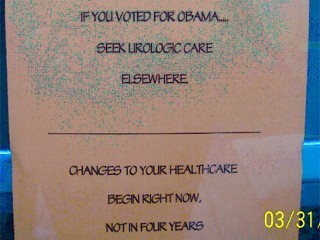
Someone who shouldn't be a doctor


This sickens me. I would hope that other doctors in the area realize that he's an asshole who won't treat his patients equally and refer their patients with urological problems elsewhere.

(part of me thinks, I'm glad that he's advertising his idiocy and losing patients)

Sunday, August 16, 2009

Jesus is my co-surgeon

The hospital that I'm working at now (St. XXXX) is affiliated with the Catholic church. I am not a big fan of mixing religion with anything, but I really think that it's unfortunate that so many church-affiliated hospitals exist. For most patients it's not a big deal and it rarely affects them. Sure, there are crosses in every room, Bible quotes in the hallways, and bright notes on the front of charts saying "Sacrament of the sick given" (apparently that's more important than "Allergic to penicillin"), but I pretty much see that as (really bad) decoration. There are some things, though, that I think are not appropriate in a place that is meant to take care of the entire community (especially since people in this half of the state really have no other choice in a major hospital).

One is that there is a rather long, loud morning prayers on the intercom every day (usually at a time when we're rounding on patients). It's not just, "let's take a moment of silence" or something else equally nonspecific... rather it is usually a five-minute sermon on what Jesus or some saint said. Even though it's a rural part of the country, not everyone is Christian or religious (and they're definitely not all catholic). The last thing I'd want to hear when I'm sick in bed (especially if it's during the five minutes that my doctor is talking to me) is what Jesus wants me to do.

What really bothers me, though, is the fact that church doctrine dictates medical decision making. Catholic-affiliated hospitals (which care for approximately 20% of the patients in the US) all follow the US Conference of Catholic Bishops' Ethical and Religious Directives . Since it affects a fifth of patients in the country, it's a must read for healthcare workers. Some of the more striking parts are:

- #24: The institution ... will not honor an advance directive that is contrary to Catholic teaching.
- #25: Each person may identify in advance a representative to make health care decisions as his or her surrogate in the event that the person loses the capacity to make health care decisions. Decisions by the designated surrogate should be faithful to Catholic moral principles.
- #36: A female who has been raped should be able to defend herself against a potential conception from the sexual assault. If, after appropriate testing, there is no evidence that conception has occurred already, she may be treated with medications that would prevent ovulation, sperm capacitation, or fertilization. It is not permissible, however, to initiate or to recommend treatments that have as their purpose or direct effect the removal, destruction, or interference with the implantation of a fertilized ovum.
- #41: Homologous artificial fertilization (that is, any technique used to achieve conception using the gametes of the two spouses joined in marriage) is prohibited when it separates procreation from the marital act in its unitive significance
- #45: Abortion (that is, the directly intended termination of pregnancy before viability or the directly intended destruction of a viable fetus) is never permitted. Every procedure whose sole immediate effect is the termination of pregnancy before viability is an abortion, which, in its moral context, includes the interval between conception and implantation of the embryo.
- #47: Operations, treatments, and medications that have as their direct purpose the cure of a proportionately serious pathological condition of a pregnant woman are permitted when they cannot be safely postponed until the unborn child is viable, even if they will result in the death of the unborn child. (pleasantly surprised about this one)
- #48: In case of extrauterine pregnancy, no intervention is morally licit which constitutes a direct abortion.
- #52: Catholic health institutions may not promote or condone contraceptive practices but should provide, for married couples and the medical staff who counsel them, instruction both about the Church's teaching on responsible parenthood and in methods of natural family planning.
- #53: Direct sterilization of either men or women, whether permanent or temporary, is not permitted in a Catholic health care institution. Procedures that induce sterility are permitted when their direct effect is the cure or alleviation of a present and serious pathology and a simpler treatment is not available.
- #54: Genetic counseling may be provided in order to promote responsible parenthood and to prepare for the proper treatment and care of children with genetic defects, in accordance with Catholic moral teaching and the intrinsic rights and obligations of married couples regarding the transmission of life.
- #61: Patients experiencing suffering that cannot be alleviated should be helped to appreciate the Christian understanding of redemptive suffering.


Painting in physicians' break room. Yeah, Jesus has helpful tips for the surgeon, but when a luxurious long hair from his uncapped head falls in the peritoneal cavity, the patient won't be too happy.

Monday, July 27, 2009

Social Health

3 weeks into medicine now and things are pretty busy, but I'm having a lot of fun and learning a lot. I'm still missing a lot of the knowledge, but I definitely feel more comfortable around the hospital and with patients. One thing I've noticed though is how important social situation is to health. Yeah, it seems obvious, but working in the hospital really opened my eyes about it. Of the dozens of patients I've seen, only two of them have a stable living situation. The major reason behind this is lack of access to healthcare. People who are living stable lives likely have the resources to take care of their health and even if they have a problem that can't be prevented (like a genetic clotting disorder), they can keep a close eye on it and live a relatively healthy life that doesn't require them to be hospitalized much. People who have unstable social situations have bigger things to worry about than why their stomach hurts when they eat or why they're slowly starting to turn yellow. They don't catch their clotting disorder until they get a large clot in a major vessel (i.e. the portal vein) and get life-threatening (and much more costly) health problems like losing their liver. A little early education and a $4 a month drug could have prevented a hospital stay of several hundred thousand dollars and a death in the 20's.